
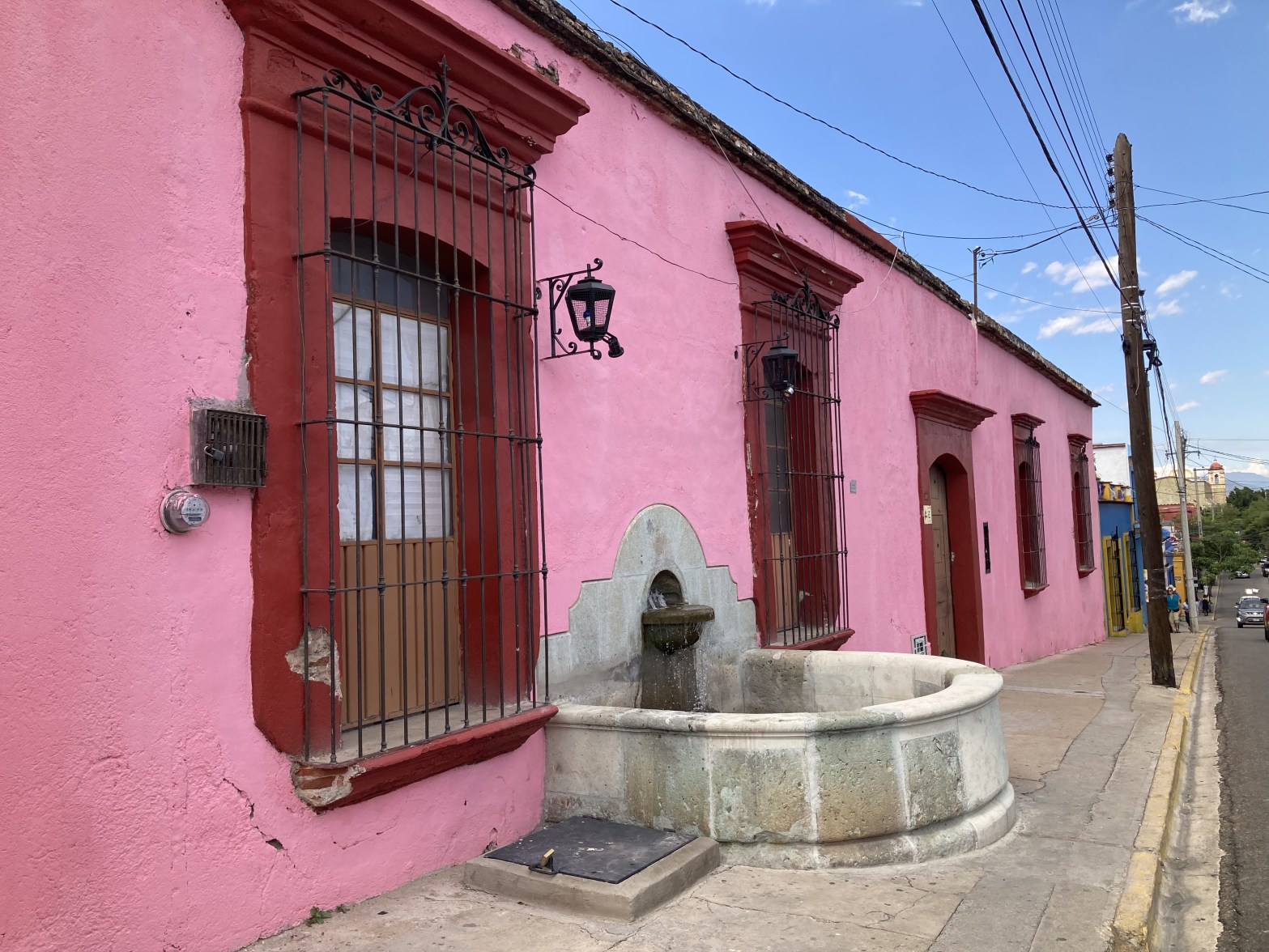
Famous for its Day of the Dead traditions, Oaxaca had been on my Mexico bucket list for quite some time. Little did I know, but when I researched the area, I also discovered that Oaxaca is a mecca for cultural experiences, fascinating history and amazing natural wonders. During my visit, I managed to try vegan Zapotec cuisine, learn about a civilization dating back to the 6th century and visit the widest tree in the world. What a week!
Day One
I flew into Oaxaca on Volaris Airlines from Cancun with a few friends to celebrate my friend Erick’s 50th birthday. We took a shared taxi into town which costs 115 Mexican pesos per person. It turns out that taking a taxi is the only way into town and the line was long, but moved quickly.
After sitting only a few minutes in the back of the van, I felt my chest tighten, my heart beat faster and my breath became belabored, reminiscent of my time in Santa Fe, New Mexico. Only then did I realize that Oaxaca sits at a much higher altitude than Cancun. It turns out that Oaxaca City lies at an altitude of 5100 feet (1555 meters).

After checking into the Golondrinas Hotel, and relaxing for a bit, I began to feel a little better. I remembered from my time in Tibet that the key to combating a swift change in altitude was drinking lots of water, so I began doing just that. We all ate a small lunch at Citronella, a vegan restaurant only a 3 minute walk from the hotel. The wide archway of the façade opened up into a nice little courtyard with a few small tables. I ordered the ceviche vegana and enjoyed the crunch of apple and jicama. I also tried my friend’s avocado toast and I must say that both dishes were very subtle in flavor, instead of the boldness I usually enjoy.
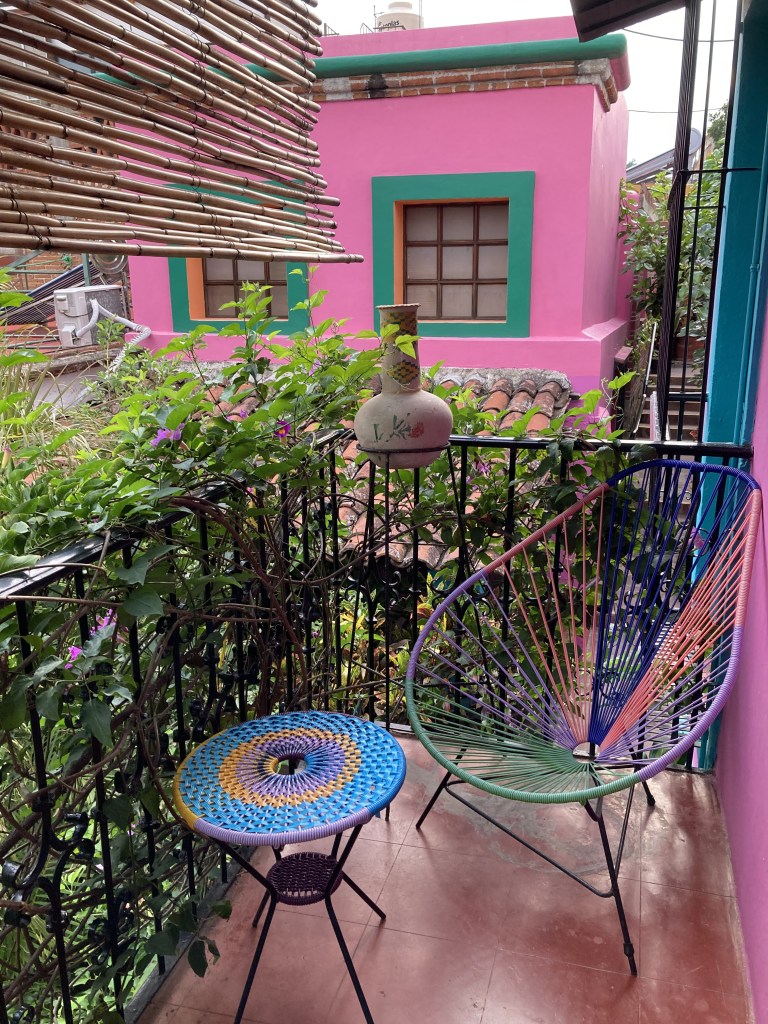
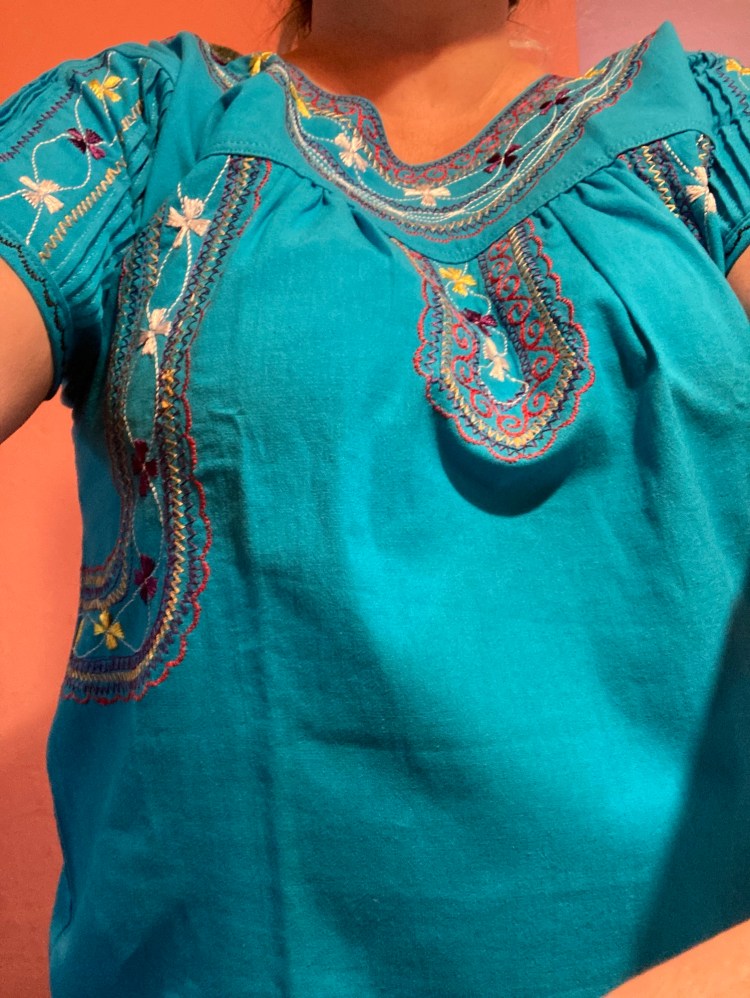
On the way home, I stopped into a local seamstress shop and placed an order for two tailored Oaxacan-style shirts for myself. I chose two different styles and one in an aqua color and the other in a pale pink. After taking my measurements, Mercedes the seamstress told me to come back the following Tuesday, in only 5 days’ time. I left the shop excited and owing 1400 Mexican pesos (about $82 USD at the time of writing).
In the evening, we all went to dinner on the rooftop of Oaxaca te Amo. There were several vegan items marked on the menu and a few others, like the mole negro, that could be made vegan. I loved the view from the lofty terrace. Restaurant patrons could easily see the cathedral with a backdrop of the mountains and the rich blues of the twilight sky. The cool breeze brushed gently across my face; it was a beautiful night.
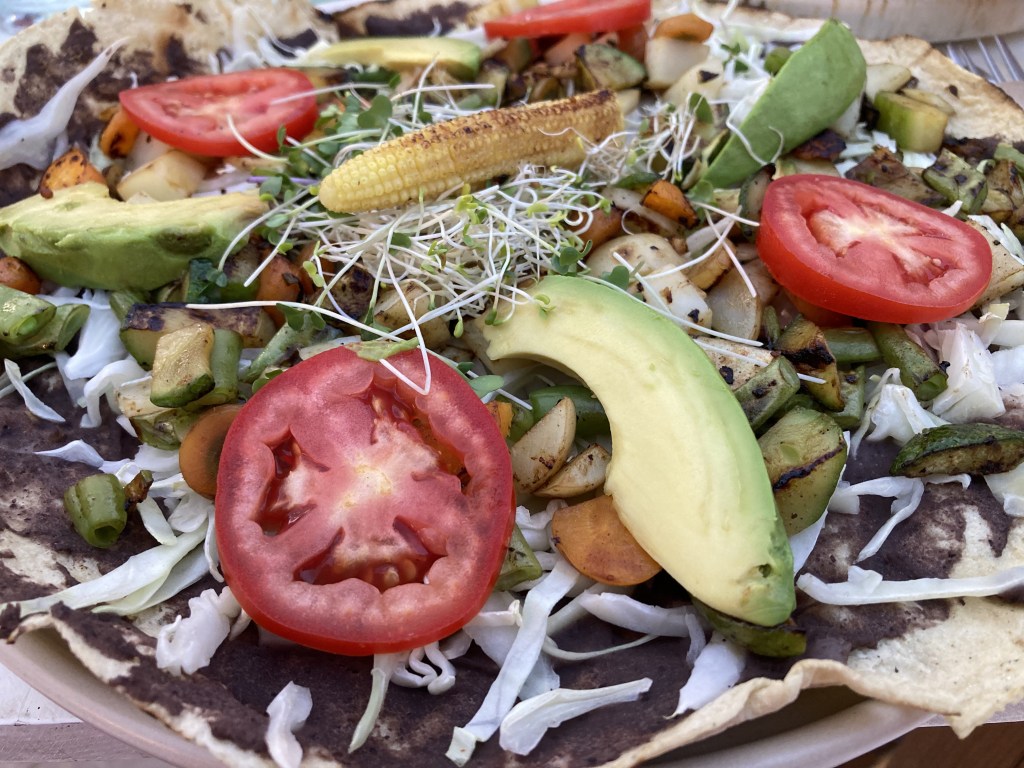
I ordered a tamal vegano (stuffed with mushrooms, pumpkin flowers and dry chili) as an appetizer and the tlayuda vegana as the main. This very filling dish is local Oaxacan and consists of a large crispy corn tortilla layered with refried black beans, sautéed vegetables and topped with fresh tomato slices and avocado. Both of these dishes were fabulous!
I left the others and walked home for an early evening. I fell asleep listening to the rain fall softly on the roof. And, I was excited for our group tour the following day.
Day Two
On my first full day in Oaxaca de Juarez, I did something I rarely do: take an organized tour. As we all filed into the already full van, I was very quickly reminded as to why group tours are not my favorite way to travel. We were taken to several tourist traps, where they teach you about how textiles, candles or mezcal is made and then pressure you to buy overpriced merchandise.
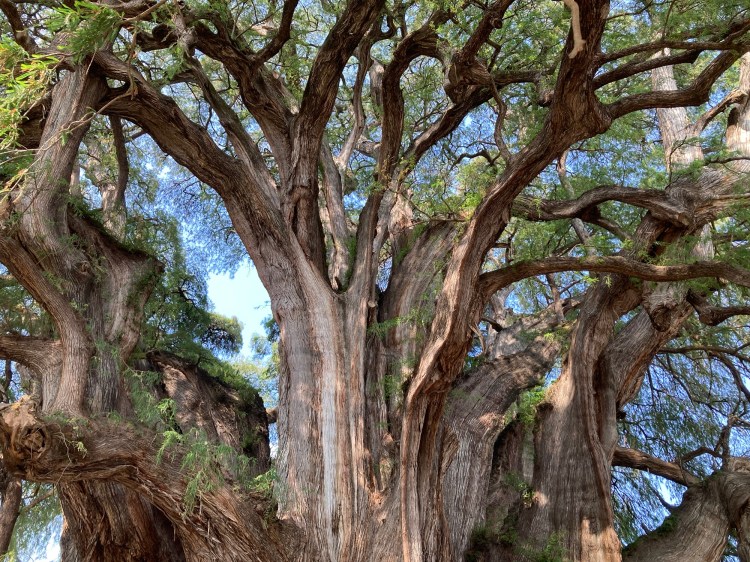
But, there were parts of the tour I did enjoy. Our very first stop was actually quite the highlight for me: the Árbol del Tule (the Tule Tree), reported as the widest tree in the world. More astounding, in my opinion, is that the tree is believed to be over 2000 years old, with her offspring at a young 1000 years old flourishing only yards away. Entrance tickets only cost 20 pesos and it was worth it just to be in the presence of such a majestic soul. I also loved listening to the birds that have made this tree home.
Not surprisingly, there were many vendors in this area selling a variety of items that included two pre-Hispanic Oaxacan drinks that happened to be vegan: tejate and agua fresca de chilacayota. Tejate is made with toasted corn, fermented cacao beans, pixtle (toasted and ground mamey pits), and cacao flowers. The ingredients are ground into a paste and mixed with water and reportedly stirred by hand into a smooth mixture. This frothy beverage is usually drunk with ice or some added sugar. Chilacayota, also referred to as Asian pumpkin, black seed squash, fig-leaf gourd and Malabar gourd, is a species of squash known throughout the Oaxaca region for its edible seeds, fruit and greens. I loved trying both drinks.
The next stop on the tour was a tourist trap: a place where they show you how they dye textiles using insects that feed on cactus leaves and a subsequent opportunity to buy expensive woven products. It was there that I learned that the ingredient known as carmine oil is actually an insect. I enjoyed watching the guide demonstrate weaving on a huge loom, using his hands and feet. All the woven products for sale where quite beautiful, but I did not purchase anything as they were made from wool and, with the exception of the gray and white weavings, all the products contained the insect-dyed colors.
The next tourist trap was just around the corner: a candle-making demonstration followed by the opportunity to buy all sorts of souvenirs made with beeswax, as well as other items. The only aspect of this section of the tour I enjoyed was the part where the speaker talked a little about Oaxacan wedding traditions. She talked about how flowers were important and so candles in the shapes of flowers became traditional. I must admit that the details in the flowers candles were quite impressive.
Our final stop before a rather disappointing lunch buffet was Mitla, an archeological zone showing a mixture of Zapotec and Colonial Spanish architecture. Mitla is totally unique to the area and was built by carving stone. I enjoyed learning about the Zapotec symbols, such as the diamond (with a cross in the middle indicating the four directions), thunder, life and water. There were more designs present, but it is unknown as to their symbolism. A Spanish church stood next to the Zapotec ruins and it was obvious that the materials to make the church had been taken from the Zapotec structures, destroying much of it in the process.

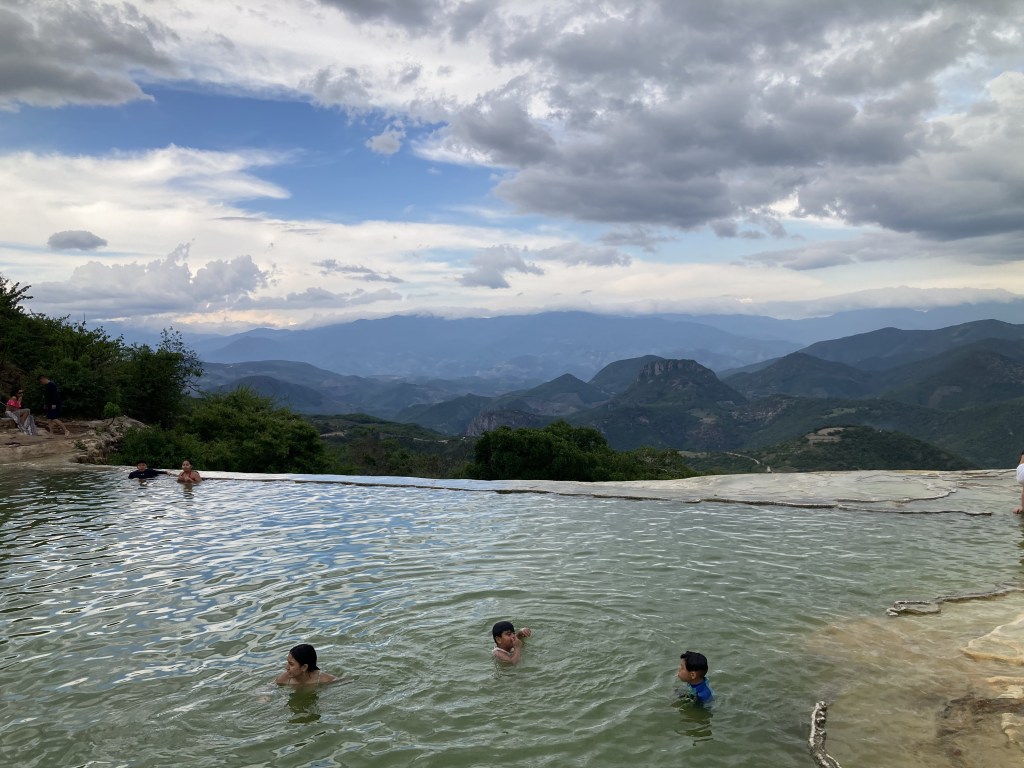
Without a doubt, the highlight of the tour was seeing the petrified waterfalls at Hierve de Agua. I was very excited to see this natural beauty as I was struck by the pictures online when looking up things to do in Oaxaca. Little did I know that it wasn’t just the waterfalls and neighboring pools that were amazing, but the surrounding area was incredible! I must admit that I found it challenging to climb up and down the paths to the various pools and waterfalls, in part due to the altitude.
Our final stop on the bus tour was a mezcal factory where we learned of the process of making mezcal. We were then invited to sample a variety of mezcals, biting into chili-covered orange slices between shots. We were told to smell it, swish it around in our mouths, swallow it and then take a deep breath. The result was a tingling sensation on the lips and tongue. The only mezcal I opted out of was the 6-month aged one because it included a worm in the bottle.
I also learned that some mezcal factories use horses to grind what they call the “pineapple” (the part of the agave plant that gets smoked and made into mezcal). This involves attaching a horse to a large heavy wheel and forcing her/him to walk in a small circle for three hours, until there is enough to fill a large container of material that will then get heated and fermented before being distilled twice. I confirmed that not all mezcal factories do this, so it is possible to find mezcals in the stores without using animals in the process. But, it will take some research to know which companies do this and which do not.
It was a long drive back to Oaxaca de Juarez (about an hour) and during that time we all sang happy birthday to Erick at the exact moment that he was born 50 years prior. Upon our return to the city, we went to Hierba Dulce, known for their focus on vegan local cuisine, for a late dinner. We enjoyed the mushroom adobo tacos.
Day Three
My third day felt very much like a very Oaxacan day from learning about endemic Oaxacan plants and some of their medical benefits to trying traditional Oaxacan food and drinks.
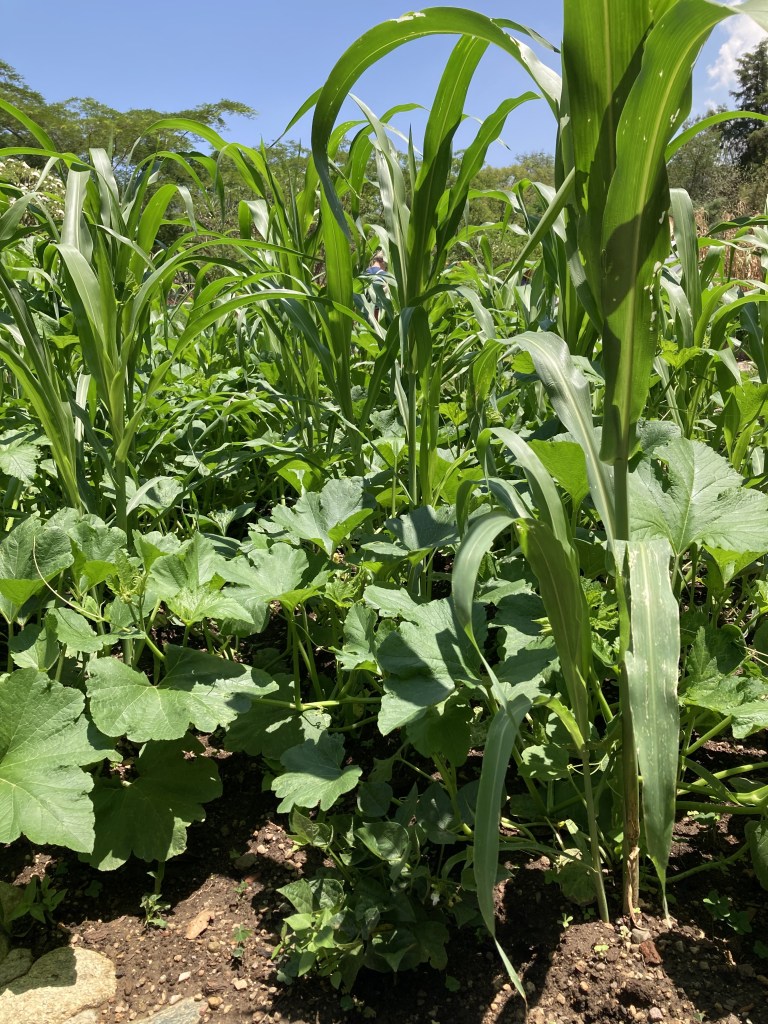
The day began with a tour of the Jardin Etnobotanica (Ethnobotanical Garden). The online schedule reported that a tour in English was scheduled every Saturday at 11am for 100 pesos, but when we arrived, we discovered that it had been cancelled for some unknown reason. So, we took the Spanish tour instead for 50 pesos. Although I could not understand the tour, it was nice to view the local plants. I even recognized a milpa (Nahuati word for “cultivated field”), which is a traditional Mesoamerican way of gardening that includes corn, squash and beans.
In the evening, I dined at EtnoFood, a mostly vegan restaurant specializing in Zapotec cuisine. I began with a pre-Hispanic Oaxacan chocolate (with water and chili) which was very delicious. I ordered their mole bowl, made of a baked tortilla with organic corn from Itsmo, bathed in traditional Oaxacan black mole with mushroom, lettuce and vegan cheese. I liked the earthy flavors of this dish. I completed the evening with some margaritas made with local mezcal and due to some major confusion about the menu, almost ate a non-vegan dessert. I had ordered it because I thought we were at a vegan restaurant and when the waiter brought the chocolates to the table, he happened to mention that they had milk in them. Thankfully, this was mentioned before I tried them.
Later that night I went to a very unassuming place called Mezcalerita. Up on the their rooftop deck, I tried a drink known as pulque, yet another alcoholic drink stemming from the agave plant (others include tequila and mezcal). Pulque is made by cutting a hole in the “pineapple” (the pineapple of the agave plant what it’s called after the leaves have all been removed) of the agave and the agave juice flows into the hole. The juice is then collected and fermented.
Mezcalerita offered four types of pulque: natural (with no flavorings added), mango, guava and strawberry. I wanted to try the natural first so I could experience the unadulterated taste before tasting other varieties. I tried all four and while I can report that they were all delicious, my favorite was the guava.

On the walk back to my hotel, I started to get a sore throat. Despite having had some alcohol, it was a rough night sleep.
Day Four
After a terrible night sleep with a sore throat that could no longer be attributed to anything other than a cold, I went with the others to La Selva de los Gatos. This outdoor vegan eatery serves as a cat rescue and all proceeds go to the care and rehoming of cats. Cats freely walk around and interact with patrons as they wait for their food. Our group ordered a sandwich de choriqueso, ceviche de jicama, smoothie bowl and oat pancakes. Everyone was pleased with the meal and loved playing with the kitties.

And on the way, I twisted my ankle on uneven pavement. I was reminded of my experience hurting my ankle in Agra, India and knew I needed to stay off of it, elevate it and ice it. Knowing all the steps and walking required to visit Monte Alban, I sadly, but smartly, opted out of the afternoon activity.
The others went to Monte Alban, which is free for Mexicans on Sundays should you be traveling with any Mexican citizens like I was. They took a shuttle from Zocalo with Lescas Co Tours for 120 pesos roundtrip. The shuttles leave Zocalo every hour on the half hour and leave Monte Alban every hour on the hour. My friends said the company was easy to find and everything worked as described. They also told me that the driver went very fast at some points along a dirt road and some of the passengers were mildly freaking out as to how close the van was to the edge. This would have definitely triggered my fear of heights, but these drivers run this route many times a day and are hence highly familiar with the roads. I was also told that there is virtually no shade at Monte Alban, so bring a hat or umbrella and sunscreen accordingly.
Day Five
The following day was a bit disappointing overall, but I managed. My cold was full-fledged and after taking yet another dose of cold-medicine, I walked to Etno Food to take the mole class I had signed up for with my friend Erick. Knowing that his grandmother making mole was a special memory of his from his childhood, I gifted this class to him for his birthday.

The course began by meeting the others in the class in the little courtyard in the back of the restaurant where I had eaten a couple days prior. Others in the class included several young women who had traveled all the way from New Zealand. Juan, the director, turned out to be our teacher and he began by telling us a bit about the Oaxacan culture (his culture) and asked each of us what we had hoped to gain from the class. This gave Erick an opportunity to tell a bit about his memories of his grandmother.
Juan took us on a bit of a walkabout where he pointed out various interesting points in the city on our way to the market, where he bought some fresh ingredients needed for our meal. Once back at the restaurant, we stepped into the kitchen and began working. Juan gave everyone a task to do. A couple hours later, we all sat in the back and shared the meal together. To be honest, I was disappointed with the class as it didn’t focus on the mole like I had hoped. The others in the class had signed up for the vegetarian class and I think they just lumped us all together.
The following is the review I put on Happy Cow after the experience:
I enjoyed the food and the atmosphere (beautiful little courtyard in the back of the restaurant). The staff was VERY friendly, but I ordered the Symphony of Cacao for dessert only to learn that it has milk powder in it. The waiter explained that they have a sister restaurant that is vegetarian and those chocolates came from them. Our waiter was very nice, but was super absent-minded. We needed to reorder things several times.
I also signed up for the mole class (as opposed to their vegetarian cooking class and asked ahead of time to confirm the mole class was vegan only to be assured that it was after explaining that the vegetarian cooking class was from their sister restaurant which was vegetarian) only to discover that this was not a vegan cooking class, which is what I would have expected from a restaurant that claims it’s vegan. We were instructed by Juan, the director, who was very friendly and had a great personality. Although we did make a mole (mole amarillo), it wasn’t the main focus of the class. Instead, it felt like a vegetarian cooking class and he didn’t use different pans/utensils/cutting boards for the dishes with cheese (including quesadillas) and the dishes without. The food was very tasty and it was nice to sit with the class after our hard work.
I thought it was a fair review, but the response from the management, where they referred to me as picky and a cranky old woman, left a very bad taste in my mouth. Why not just listen to the concerns of someone who dropped quite a bit of money in your restaurant? The nastiness was uncalled for and for this reason, I would not go back to this restaurant.
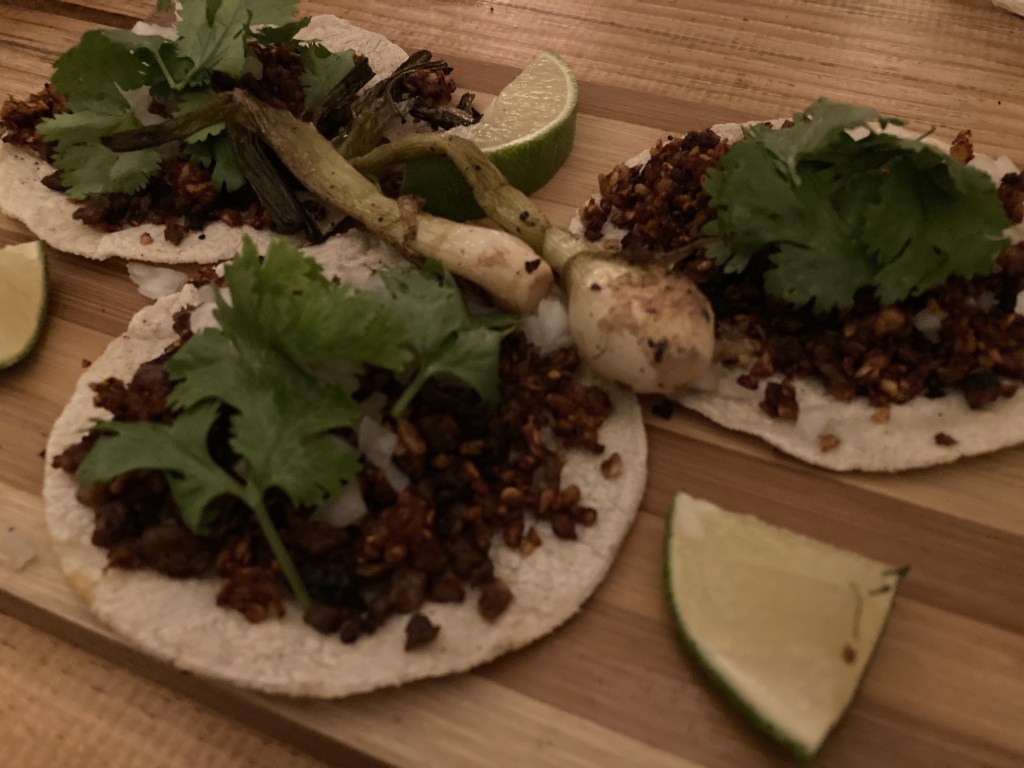
Later that night, I had the most delicious tacos in all of Oaxaca! It totally turned my day around. A little hole in the wall called Herbivora offer tacos made from scratch and I tried them all: babacoa, alambre, papa con chorizo, milanesa, pastor and campechano. Each taco was very well thought out and tasted amazing!!! Herbivora ranked number one for me due to the phenomenal flavors that were so good in fact, that I went back the following night for dinner as well.
Day Six
The following day was my last full day in Oaxaca and I couldn’t wait til I got to pick up the clothing I had ordered. In the meantime, I spent some time walking around Zocalo, including an artisans’ market.
I was so tired and felt so sick that I sat down for a rest on a park bench right across from the Catedral Metropolitana de Nuestra Señora de la Asunción (Cathedral of Our Lady of the Assumption) and promptly fell asleep.

Eventually, I made my way back to the hotel, stopping at the clothing store along the way. I loved the two vibrant shirts I had purchased and they fit perfectly. I have worn them frequently since. What a treasure!
Day Seven
The next morning, after checking out of the hotel, Erick and I took a taxi to San Bartolo Coyotepec for one specific reason. I had previously learned about barro negro (black clay) that can apparently only be found in Oaxaca.
Apparently, pieces of barro negro pottery have been found at archeological sites and can be traced back 2500 years to the Monte Albán period. This traditional craft of the Zapotecs and Mixtecs involves baking black clay in this black smoke and I was told that the brown pieces are formed by allowing oxygen to get to it during the process.
I eventually found some souvenirs that caught my eye: a calavera (skull) and two small bowls bearing the name Oaxaca. Once home, I placed the calavera next to other travel souvenirs like my trolls from Norway, my Moai statue from Easter Island and my Kali goddess statue from India. Only a few months later, I used the two bowls while celebrating my 11th veganniversary.

Before heading to the airport, the taxi driver took us to a small, almost hidden, restaurant down a narrow side street. I asked for tortillas and black beans and enjoyed watching them being made using a traditional style of making tortillas using a comal. I also tried the two salsas on the table as well as the escaveche and I drank atole (a Mexican drink made from corn). What a great way to end my Oaxacan adventure.
I flew back to Cancun with Volaris having had a wonderful week of new experiences. What a wonderfully beautiful and interesting part of the world! Hopefully, next time I go, I will not be sick and will be able to explore even more!
 Vegan Vixen Ventures
2 thoughts on “A Week in Oaxaca, Mexico”