

“Thank you”, I told the taxi driver, “have a safe drive back to Delhi”. It felt good to step out of the car after the four hour ride. I put on my small backpack and took in my surroundings as I navigated the remaining 650 meters to the guesthouse on foot through increasingly narrow alleyways. I passed vendor stalls selling very different wares to those I had seen in Old Delhi. Haridwar shops sold targeted items such as marigold flowers, diyas (lamps), sindor (a brilliant scarlet powder used during Hindu religious and cultural ceremonies), deity statues and bright orange plastic containers that I later learned were for collecting Ganges water. Theism and piousness filled the air.
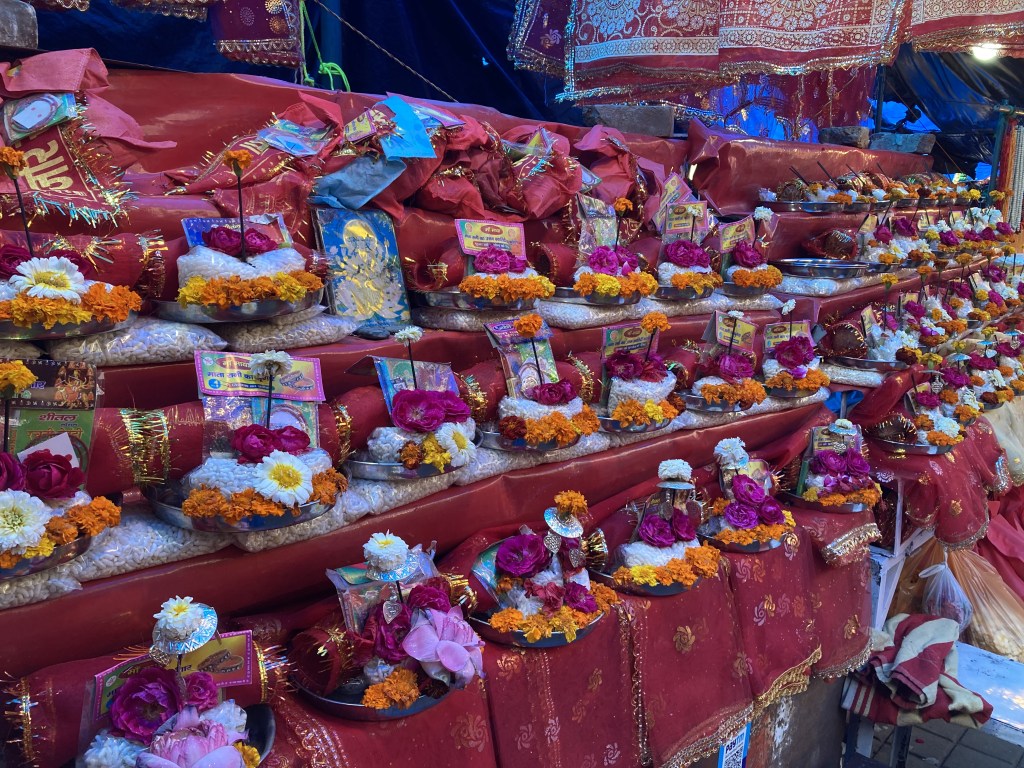
Despite the fact that I was eager to lay down my backpack at the guesthouse, a glimpse of water between two buildings to my right caught my eye and I had to go investigate. I followed the narrow dark passage towards the light and suddenly I found myself standing on the shore of the Ganges. THE Ganges! I felt a strong feminine energy from the cool breeze as the sheer power of the mighty waters rushed by. The gravity of this moment was not lost on me. Haridwar is where the glacier-fed Ganges River exits the Himalayan foothills and touches the plains. Hindus travel from all over India to this sacred city to embark on a puja (Hindu pilgrimage). Some bring ashes of a deceased family member to gain salvation and take part in a ritual bath to cleanse sins. Being 500 miles upstream of Varanasi, perhaps the most famous location in all of India for taking a holy bath, I wondered if I might, at some point during my five-day stay in Haridwar, be persuaded to dip my feet into the Ganges and feel the sacred waters rush over them. I was happy that I had added Haridwar to my Indian itinerary.

What’s in a name?
Hindus consider Hardiwar the “Gateway of the Gods”. I learned that this holy city goes by two names, depending upon whom you ask. Shaivites, followers of the Hindu god Shiva, call it Hardwar because Har corresponds to Shiva, yet Vaishnavites, followers of Vishnu, refer to it as Hardiwar because Hari is another name for Vishnu.
The Patnimal Guesthouse
Once the royal retreat to oversee the Ganga ceremonies, the Patnimal Guesthouse is now accommodations for travelers. Befitting its noble heritage, this 400 year old palace sits right on the river and has its own private, though small, ghat for the guests. No longer used by India’s royal family, it is still recognized by the locals as a significant site. The first view of our room did not disappoint as the large windows provided us and up close and personal view of the Ganges.
Observing the Ganga Aarti (River-Worshipping Ceremony)
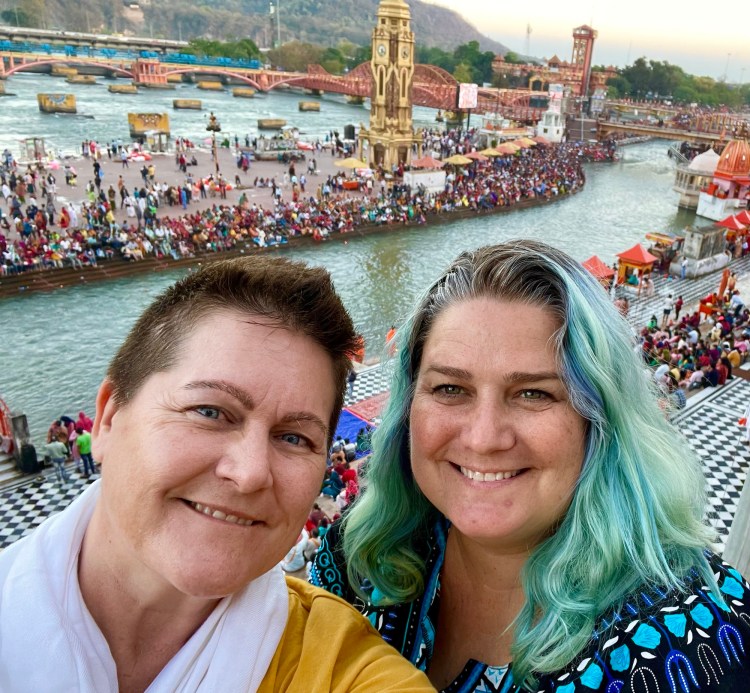
On our very first night in Haridwar, Chrissy and I observed the nightly Ganga Aarti at Har Ki Pauri, the largest of several sacred ghats (bathing steps). Let me begin by explaining that the Ganges River is not just a river in India; it’s the Divine Mother that gives life, and has the power to remove sins, cure illness and can liberate souls. Millions of people have been living on the banks of the river for thousands of years making it a whole culture unto itself. From what I could ascertain online, the Ganga Aarti (occurring twice daily at sunrise and sunset) is a devotional ritual that uses fire as an offering, a ceremony celebrating the River Goddess, Ganga.

And what a place to people watch! We found a spot to stand that allowed us to witness the holy Hindu event from above. It was interesting to watch workers prepare for the proceedings by sweeping the diamond-patterned black and white marble floor, lay down red carpets and ensure that the Hindu priests have everything they need. I enjoyed observing the participants find the perfect spot with their families. For many, maybe even most, Hindus who live far from the river, participating in a Ganga Aarti in Haridwar, is a once-in-a-lifetime event. People arrived hours early to claim a good spot.

The sun began to set and the ceremony began. Hindu priests (called pundants) carried a Ganga idol from the small ornate temple down to the platform next to the water. The priests began chanting mantras that came out of the large loud speakers that had been placed up high on the shores of the river. The priests put milk, followed by brightly colored power into the water as an offering to the river Goddess. Orange flower petals on diyas with lit candles were also sent downstream.
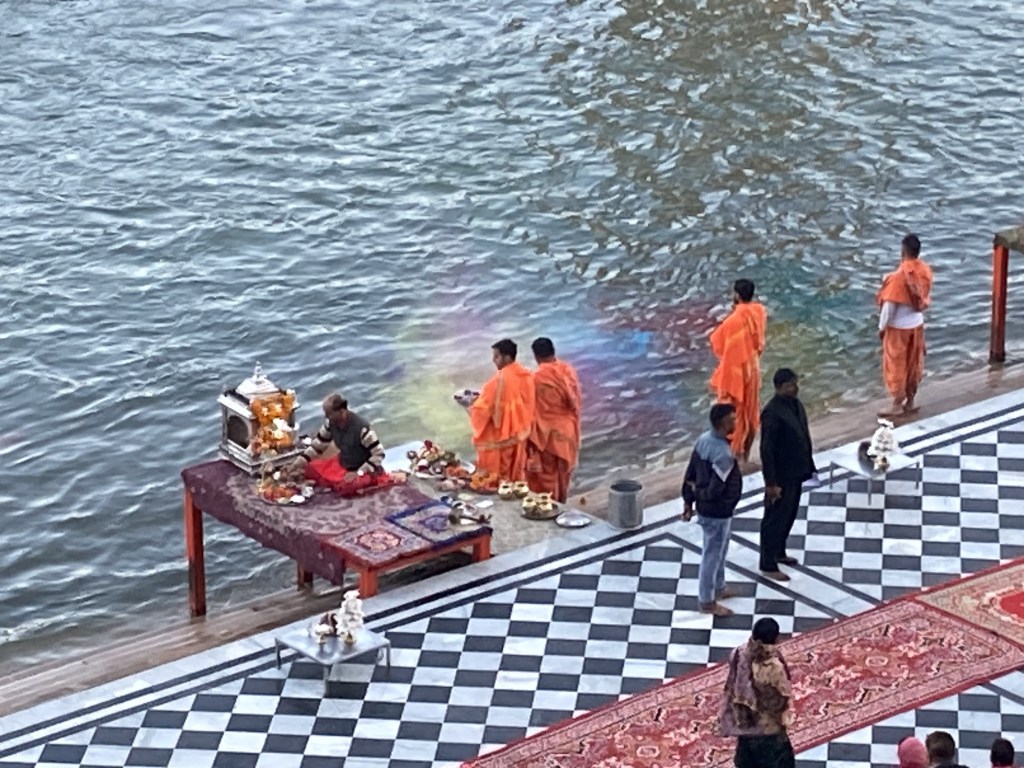
One of the most beautiful parts of the ceremony, in my opinion, was the singing that followed. A subsequent online search revealed that the priests and participants alike were singing the Ganga Lahari, a poem in Sanskrit written by a scholar and poet born in 1590 named Pundit Jagannath. The poem is a mixture of telling the origin story of the Ganges River (through the goddess’ hair) and sheer adoration of these holy waters. Here is one of my favorite sections of the poem. I think it speaks to why Hindus treasure the Ganges River so deeply:
“I have no protector and you are soft with love; I have strayed from the path and you provide the pious state; I am fallen and you hold aloft the universe; I am stricken with disease and you are the proven doctor; I am thirsty due to greed and you are an ocean of ambrosia; I am a child and you are the mother; I have come to you here and now and you do as you deem it proper.”
Upon reflection, it would appear that Hindus regard the Ganges River similarly to the way many Christians view Jesus Christ, someone who can save them from sin and as having power and wisdom greater than themselves. If you are interested in reading the poem in its entirety, click here.
The participants promised not to pollute the River Ganges by raising their hands as they chanted her name. This act reminded me of witnessing a similar scene in Baptist churches where people raise their hands and say, “Praise the Lord”. And not unlike a collection plate, the Ganga Aarti included men who came around to ask for a donation.
The pundants lit lamps along the water and spun them in a clockwise manner while the Ganga Aarti song played on the loudspeaker with the background music of bells. Hindus believe that the lamps acquire the power of the deity through these actions. It is no wonder then that after the ritual is complete, devotees will rush to the lamps cupping their hands over the flames and raising their palms to their forehead, receiving the Goddess’ purification and blessing. The very end of the ceremony reminded me of smudging, common in many Indigenous tribes in the Americas.
One of the many aspects I came to appreciate about the Ganga Aarti is that it includes the four elements: earth in the orange flowers, the air in the movement of the incense and of course the fire in the lighting of the lamps and the water of the river itself. I have found throughout the decades of traveling around the world, that most, if not all, religions contain these four basic elements in some form.
Accidentally Joining a Puja
The next morning we decided to visit the two major Hindu temples in the area, one on either side of the Ganges. Staying at the Patnimal Guesthouse (Kusha Ghat) allowed Chrissy and I to easily walk to the ticket office for the Shri Mata Mansa Devi Mandir Hindu Temple where we bought a combined ticket plus transport up the Bilwa Mountain, interestingly among the southernmost mountain chain of the Himalayas.
We were expecting to simply check out a couple famous Hindu temples, observing and hopefully learning. While ascending the mountain in our gondola car, enjoying the incredible views of the surrounding area, little did we know what truly awaited us at the top.
We were ushered out of our private gondola and very soon after men started yelling at us pointing at our feet. Clearly, wanting us to remove our shoes, we looked around and saw that others had not removed theirs so we kept ours on too, still moving towards the temple noticing people’s feet as we stepped closer. Vendors were selling all kinds of offerings in the form of flowers and gold, in addition to offering to store our shoes for us. When we got to the point where we saw Indians remove their shoes, we did the same, placing them in our bag that we had brought specifically for this purpose.
After a little more walking, now barefooted, we reached a line and joined a crowd of people. Chrissy and I were the subject of curiosity of others in line. Some wanted to know where we were from and one man encouraged me to repeat a few Hindu phrases after him. To this day, I have no idea what I was declaring, but it received friendly cheers from the crowd and seemed to bring genuine happiness to many.
Once we turned a corner after inching along in line, it had become clear that without realizing it, we had become part of a puja and our presence received mixed reactions from other participants. While some gave us disapproving glances, others seemed pleased we were there and were happy to share their religion.
Realizing this was much more than a piqued interest for everyone else there (we saw zero Westerners during the entire visit), we did our best to be respectful and follow what the others were doing. While ascending and descending stairs, for example, we touched them with our right hands. We put our hands in a prayer position when facing statues of gods, we kneeled when motioned to do so, we made monetary offerings when asked to do so, and we received blessings from a variety of purohitas (Hindu priests), none of whom seemed at all conflicted by our being there.
There were many areas, that I would describe as cubicles, each manned by a different priest, offering a blessing before a specific god. Someone who knew more about Hinduism would certainly be able to interpret the various symbols that adorned each station. But all I was able to comprehend was candles, colorful flowers, statues in various sizes, ornate tapestries, incense and offering dishes.
While there were some similarities at each station, the vibe was quite dissimilar from station to station. We were usually asked our names and where we were from followed by some chanting. The priest sometimes touched our heads, placed roses or puffed rice in our hands and once we were to bend over so the priest could hit our backs with a big padded bat. At some point, red strings were tied around our right wrists. At the end of every blessing the priest added a different colored powder to our foreheads, sometimes with beautiful and elaborate designs.
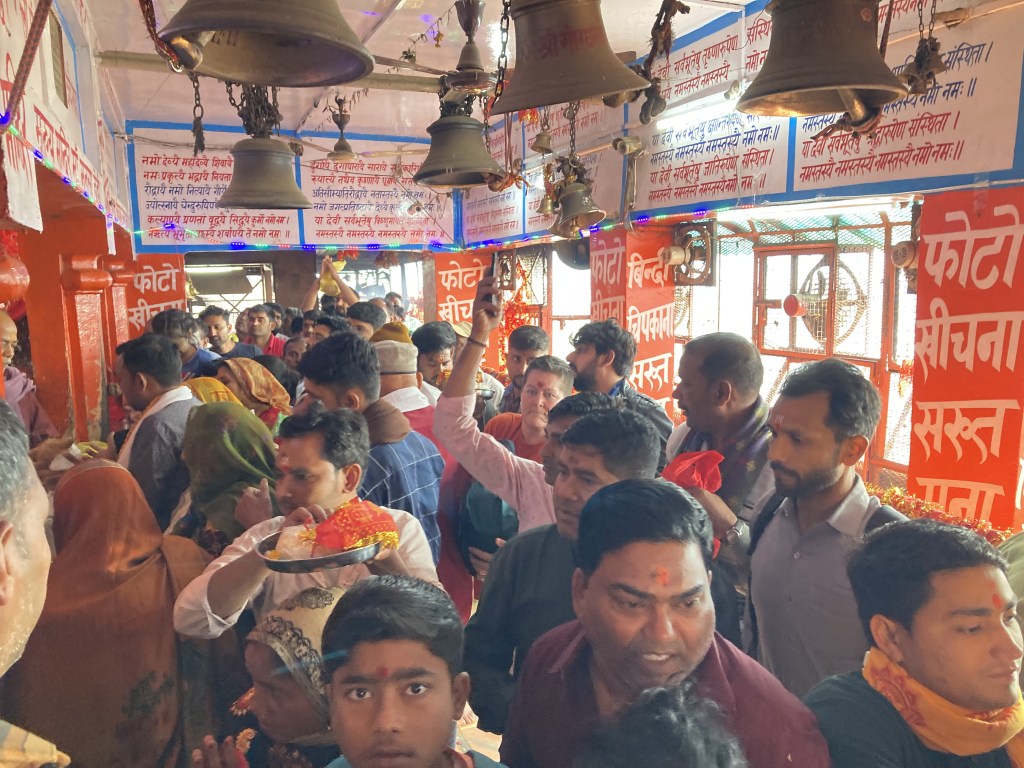
We came to a space that had become quite crowded. People were purchasing beautiful plastic flower arrangements from a long counter and placing the red flowers on the ceiling. Others were tying pieces of fabric to the railing on the opposite side of the hallway and I heard bells ring. I felt like my attention was being pulled from here to there to there, reminiscent of my experience walking down a street in Old Delhi.
I didn’t know the meaning behind anything I was observing, but I felt honored, even if uncomfortable at times, to be among the masses completing a major religious milestone. My experience at each station felt very personal, having the priests utter my individual name for example, yet I was part of a collective of persons each undergoing their own individual journey. Perhaps there is a familiarity in pilgrimages in that they reflect the very idea of what it means to be a living soul, a deeply solitary experience but in a greater population of others doing the same.
We made our way down the mountain again waving hello and saying, “Namaste” to all who were traveling up to the mountain top temple. Once on the street again, we secured the 20 minute ride over to the Maa Chandi Devi, where we once again took a gondola to reach the top. This time, however, we had more of an idea of what to expect. We once again enjoyed the views and braced ourselves for the subsequent onslaught of vendors yelling, devotees staring and asking for selfies and oh yes, did I mention macaques?

Some Indians seemed excited to see us and a few even stopped and told us a little about their religion. Strangely, I was asked on a few occasions if they could shake my hand, fully unaware of the subtleties of doing this common Western practice. For example, one girl reached for my right hand even though I was holding a rose that had just been given to me by a priest. To accommodate her, I had to switch the rose to my left hand, hoping it wasn’t inappropriate to do so. As the request to shake my hand came solely from children, mostly young teens, I got the distinct impression that they had learned about this customary salutation in school. Each seemed so excited for the opportunity to perform this greeting with a Westerner, even having their relatives take pictures of them extending their hand. Remembering the novelty I felt the first time I gave the namaste gesture (called pranamasana) in India or the similar wai gesture in Thailand, I was happy to oblige the children.
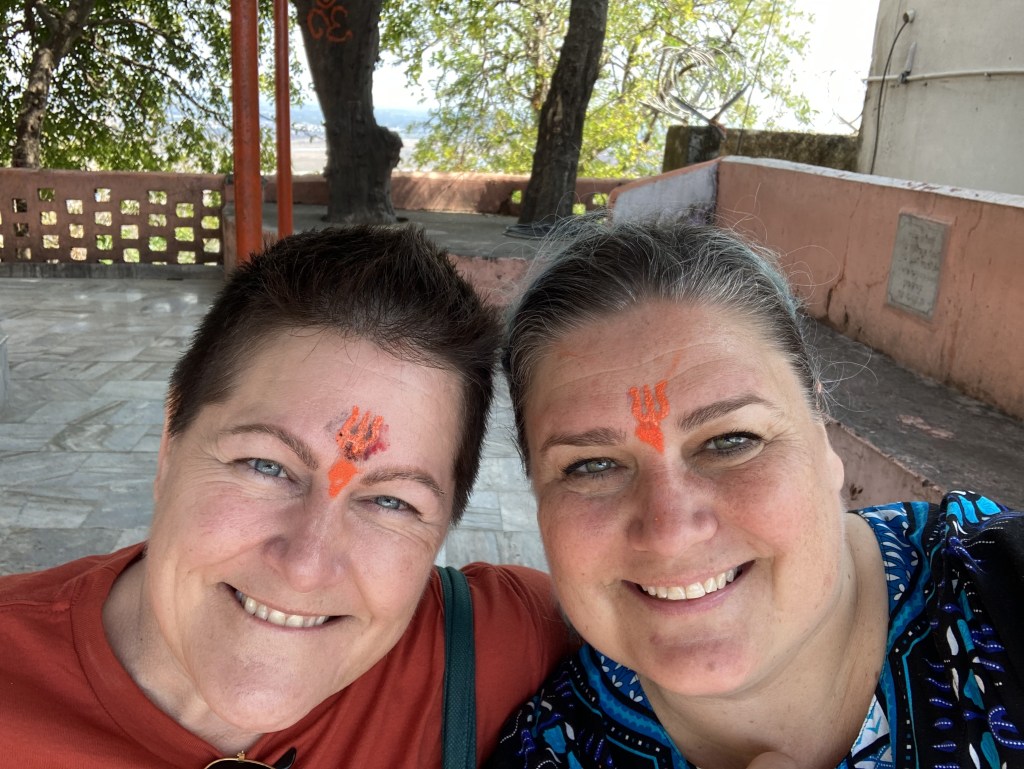
The most distinctive marking we received at the second temple was the trishula, apparently one of the most important symbols in Hinduism at it represents Shiva, the Supreme God of the real self (Atma). I subsequently learned that the three prongs of the trident represent the many trinities: creation, preservation, destruction; past, present, future; body, mind, real self).
One of the aspects that I particularly enjoyed about the Maa Chandi Devi was that there was an offering to an ancient tree. As I did with the Tule Tree in Oaxaca, Mexico, I felt a distinctly feminine energy emanating from this beautiful old and wise tree. Another feature I liked about this temple was the fact that you could actually see the bottom of the Himalayas in the distance. It was also fun to watch the macaques interact with each other and human passersby, whose reactions ranged from nonchalant and uninterested to recoiling in utter fear, most likely based on their previous experiences with this species.
Day Trip to Rishikesh
Chrissy and I decided to take a little day trip to Rishikesh, a small city on the Ganges about an hour north of Haridwar. We tried Uber for the first time in India, and it didn’t go so well. After several phone calls to and from the driver and walking a kilometer to his location (after telling us he couldn’t pick us up at the original location), he drove away and every time we got closer to his car, he would drive away again. It became clear that he didn’t want the ride, but didn’t want to cancel it.
So, we turned to local tuk tuk drivers and easily found a driver to take us up to Lakshman Jhula (bridge) in Rishikesh for 1000 rupees, which turned out to be cheaper than the Uber would have been.
The driver drove as far as he could go until a barrier blocked him and we walked the final short distance to the bridge to cross. Along the way, I noticed a significant increase of both foreigners and cows walking around. It was also significantly more hilly than Haridwar. We arrived to Lakshman Bridge, only to discover that it was under construction and therefore closed to those wishing to get across the Ganges below.

So, we walked down to the water and figured out how to take a boat across for a nominal fee. Because the boat was packed full of people and their luggage, finding a seat proved challenging. Instead of nagivating her way over people and piles of bags, Chrissy decided it was just easier to sit with the luggage up front and promptly sat down. I love how good-natured, spontaneous and resourceful she is in situations like these. The ride across the Ganges took all of 4 minutes and on the other side, we were greeted by a beautiful cow.
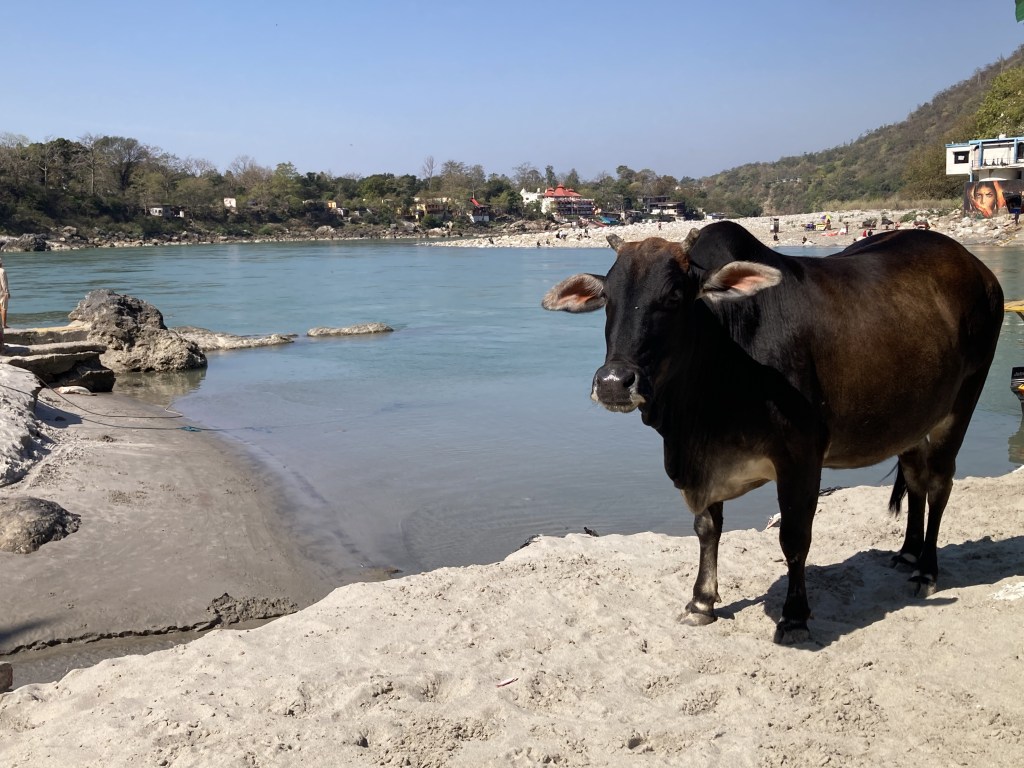
We found our way up the steep and jagged riverbank to an Ayurvedic spa, where we treated ourselves to several spa treatments, including a 90-min Ayurvedic massage, which we discovered uses lots of oil. I also opted for a shirodhara treatment, reportedly for stress release. This procedure includes slowly dripping large amounts of herbed oils onto the forehead, a very unique treatment indeed. We finished up our morning spa experience with a steam bath together.
We had a regrettable lunch at a German restaurant, but it’s hard to be too disappointed in a restaurant overlooking the gorgeous Ganges River and the mountainous surrounding area. The green color of the water reminded me of the mineral-rich Aare River running through Berne, Switzerland. Both rivers are after all fed by glaciers, the Gangotri Glacier and the Lower Aar Glacier, respectively.
After our meal with a view, we walked around the town a bit, trying to soak it all in. Ashrams, yoga and hippies seem to be quite ubiquitous in Rishikesh. We saw lots of yoga training classes, cafes with lots of Western dishes and plenty of hemp bags and clothes for sale. Indian faces were definitely the minority in that part of Rishikesh and the hilly riverside town had a very young, energetic and adventurous vibe to it. Honestly, I’m glad we didn’t stay a couple days there like we had considered, as it frankly seemed overrun with tourists. We never got tired of the views though… and the vibrant color of the water alone was worth the trip.
Eventually, it was time to head back. We hired a taxi and returned to Haridwar, and starting from the opposite side of the Ganges from whence we arrived was an entirely different experience. The way home began with a beautiful drive through a wooded mountainous road and our taxi driver had clearly taken that route many times as he whipped around bend after bend. It was a fun ride. When we got back to Haridwar, we were greeted by a gorgeous bull standing in front of our guesthouse. What a day!
People Watching and Exploring the Town
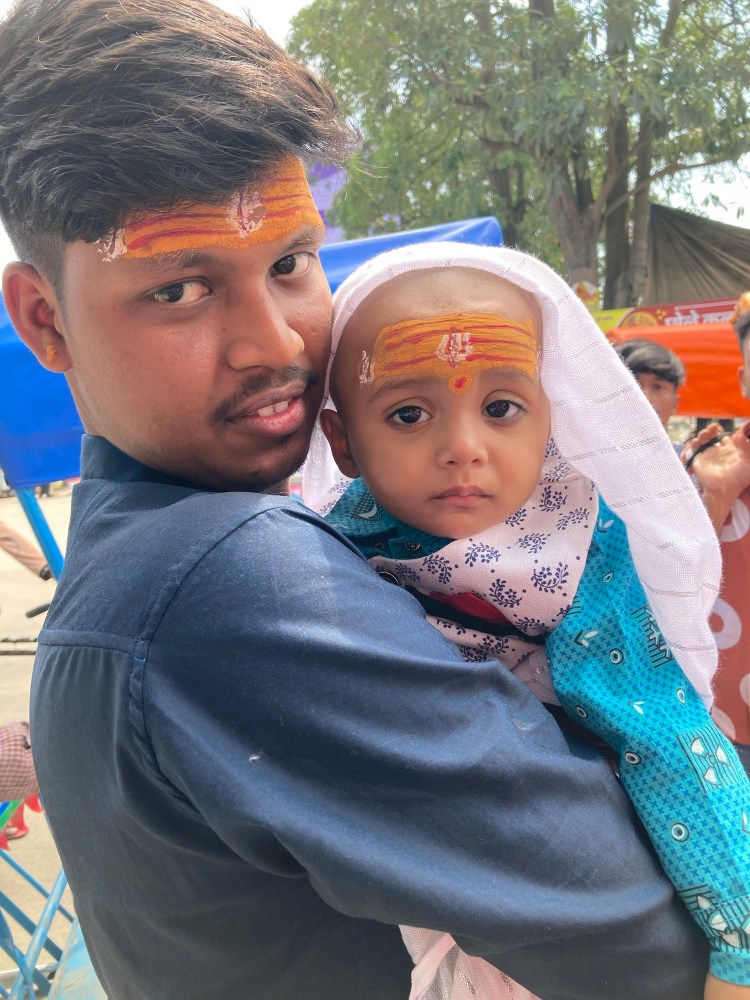
Haridwar is an excellent place to people watch. Every morning, I saw devotees getting their heads shaved at what Chrissy and I later termed “the cow place” in the alley very close to the guesthouse. I observed men standing so tightly packed together in line despite the fact that there was plenty of room to spread out if they had wanted and families braving the cold waters cleansing their souls.
I witnessed a man attempt to steal a small trinket from a street vendor table only to be caught and calmly but sternly ordered to put it back. A street dog began barking at him and terrified the man enough to recoil and hastily move to safety. He had clearly had issues with dogs before. What was perhaps the most surprising about this entire scene was that the vendor didn’t appear angry at all. Instead, he just shook his head, smiled and laughed quietly to himself. It’s as if the theft was expected somehow and therefore immediately forgiven as just a part of life. I’m of course completely speculating here and could be completely off, but he sure did seem to get over the incident rather quickly, perhaps satisfied with the immediate karma the dog had provided.
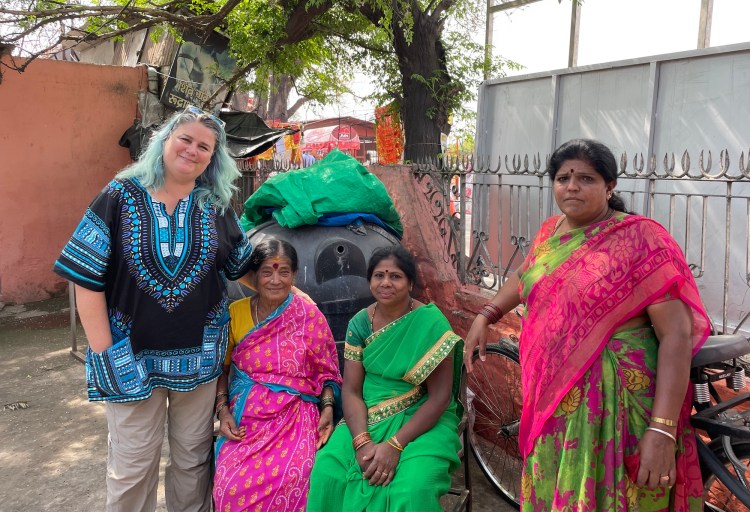
One day Chrissy and I came across a Hindu temple of Makara, the vahana (vehicle) of the river goddess Ganga. We curiously stepped inside the small temple grounds where we met three older ladies, the oldest of whom was quite intrigued by us. She came over to me and smiled with her entire face and began softly talking to me in Hindi. She motioned for Chrissy to take our picture making sure I was next to her. After, she wanted to see the picture so Chrissy handed her the phone and she studied the image closely, smiling and speaking in Hindi in soft tones. When she was satisfied, she returned the phone to Chrissy and took my hand and began talking to me again. I don’t know what she was saying, but I saw kindness and love behind her brown eyes with blue around the outside. I wanted her to keep talking.
After lunch that same day, Chrissy and I walked by a temple that had interesting sounds coming from it, including with bells and chimes. We walked inside to discover a beautiful flower garden and when a man noticed us, he came over and asked in excellent English where we were from. He welcomed us and began explaining his religion (Sannyas) to us. As he spoke, I was surprised at how comfortable I felt looking at him deep in the eyes. He spent about 30 minutes of his day talking to us about the stages of obtaining self-awareness, goodness and his view of the world. For the second time that day, I saw pure kindness behind a stranger’s eyes.
Back on the street, the most amazing thing happened:
I saw another lesbian couple!!!
There is something really special about seeing your own kind when traveling so far from home. No, I don’t mean other Westerners, or US-Americans or even Floridians. I’m talking about lesbians.
One of my favorite moments of the entire trip to India came with no build up or fanfare and was over in a matter of moments. Chrissy and I were simply walking through the crowds on a street not far from our guesthouse and I caught the eye of an Indian woman walking in the opposite direction. I knew the second I saw her, but my eyes darted from hers to the woman she was walking with and back to her. She seemed equally as surprised to see me and she glanced at Chrissy and back to me, analyzing the situation the way I was. She was clearly the butch half of the young lesbian couple and when our eyes met again, we shared look of recognition. The moment of complete acknowledgement and joy in that one instance caused us to both smile big with that look of knowing each other’s secret. After they passed, I turned around and saw that she had done the same. We both smiled again and she returned my wave.
Participating in the Ganga Aarti (River-Worshipping Ceremony)
Having observed the Ganga Aarti, Chrissy and I decided to take part in one and I’m so glad we did. Knowing the importance of securing a seat, we arrived early, just as they were closing the pedestrian bridge. Following the Indians footsteps, we purchased a piece of plastic to sit on before going to the river’s edge to find a spot. Once we did, we removed our shoes and sat down behind a several rows of devotees who had arrived even earlier than we had. Many other Hindus quickly filed in behind us.

At first, other participants stared at us and their curiosity was met with a smile and a nod or a polite “namaste” from us. Eventually, the novelty of us wore off and folks carried on with other distractions. Chrissy and I witnessed parents explaining the event to their kids and people capturing the event with photos. Anticipatory excitement filled the air. When people saw that we were actively participating (raising hands with everyone and repeating the chants as best we could), we received smiles and approving looks, especially when we too made a donation.

It was an entirely different experience being in the crowd. I really enjoyed the chanting, especially when the audience participated. There was something so powerful about chanting in unison in a large crowd. I can’t remember ever experiencing that, outside of protesting. I also liked the idea of blessing a river and promising to take care of her – what a beautiful concept. I’m so glad we went a second time.
Finding Vegan Food in Haridwar
Similar to our experience in Delhi, I found it challenging to be a vegan in Haridwar. While most people understood vegetarianism, it proved difficult for people to wrap their head around not eating any animal products, especially from a cow. “But, it’s a cow”, seemed to be the general response to our wishes not to consume dairy products. The fact that my Hindi was severely limited didn’t help matters.
Chrissy and I visited Curry Leaf, a restaurant specializing in southern Indian cuisine and located directly at Har Ki Pauri. It’s on the second floor and has huge floor to ceiling windows making it a great place to people watch. The first day, I brought my sheet of paper with translated sentences and phrases explaining veganism, focusing on the “no dairy”. Even with what I considered a clear explanation, Chrissy was still given a dish with yoghurt as the main ingredient. We subsequently learned that dahi means yoghurt. I ordered the familiar tried and true masala dosa, whose main ingredient is lentils. We came better prepared the second time, having taken pictures of the menu the last time and having looked up each dish online before our return. I ordered a uttapam and dal.

Chrissy and I ate a meal at Chotiwala Restaurant for lunch one day, where Chrissy finally had a meal she enjoyed. She ordered Indian vegetable fried rice and I enjoyed another masala dosa. The staff there seemed to very much understand veganism as our waiter was quickly able to point out which menu items were animal-free.
On our last night, we had a home-cooked dinner at our guesthouse. The staff served aloo paratha and I for one could not get enough. It tasted delicious.
Very much wanting to try Indian street food, we walked around looking for possibilities. Sadly, we had to avoid fresh fruits and vegetables due to the water that was used to rinse them. At one point, I considered the peeled cucumbers with salt and lime, just like you can find on the streets of Baja California and the Yucatán in Mexico. But, I happened to witness the vendors sprinkling water on them to keep them moist in the sun. I just didn’t want to risk getting sick.
Chrissy turned to the internet for help and found a list of vegan street foods we could keep an eye out for. This is how she learned about jalebis, a coil made from wheat flour that is deep-fried in a sugar syrup. (A thicker version of a jalebi, called an imarti, can be found in Varanasi.) And guess what?

She found them! And they were indeed fantastic and Chrissy bought some more the next day too. She also found dragon fruit, figuring the thick skin would shield the inside from any outside contaminants in the water. Chrissy reported that the dragon fruit was much more flavorful than at home, despite the fact that our home state of Florida has a thriving commercial dragon fruit operation.
Chrissy also managed to find her go-to meal when traveling: French fries. The vendors found it very odd that she wanted her fries plain, without marsala or turmeric or curried or with some “other ultra hot seasoning”(her words). The Indian French fry toppings certainly sound much more interesting than fries in the States or in Europe.

I tried street food too. One evening, when heading back to the guesthouse, Chrissy and I passed a man making fresh chapatis. After confirming there was no ghee (clarified butter that makes its way in many northern Indian dishes), I bought some to go. The next night, having improved my ability to explain veganism in Hindi, I decided to stay for a full meal. The man kindly pointed to the dishes that I could have, which included rice, dal and chapatis. I thoroughly enjoyed every bite!
Experiencing the River Ganga
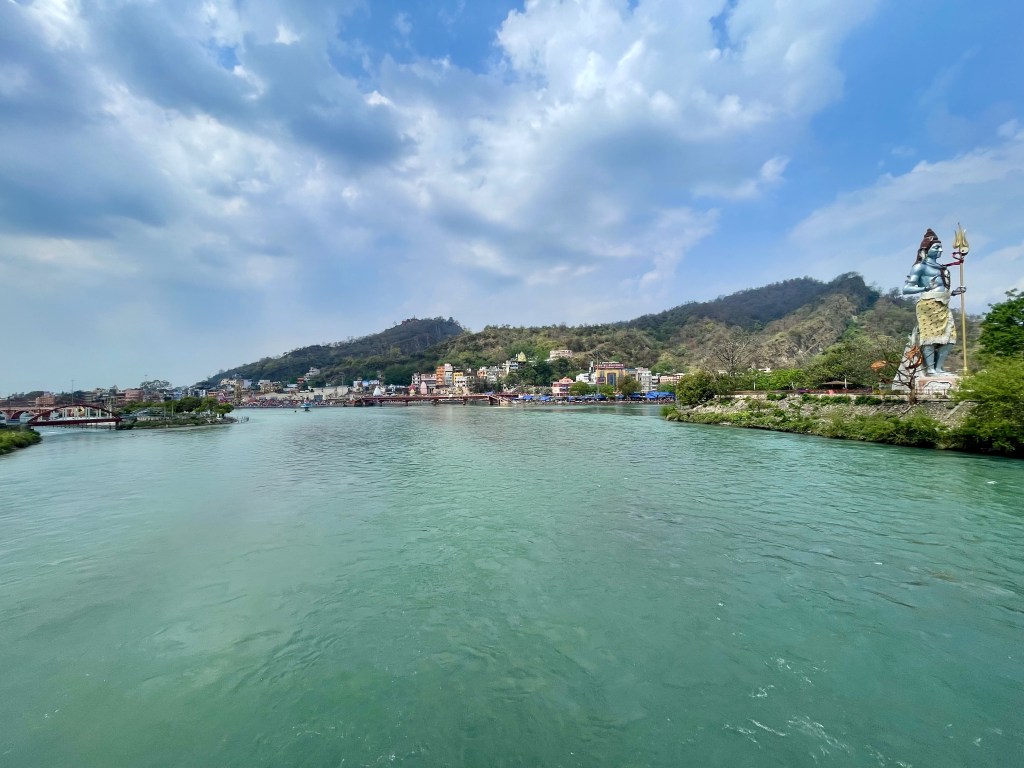
My favorite aspect of the sacred town of Haridwar was the Ganga herself. The water, carrying minerals from melting Himalayan glaciers on the border with Tibet, rushed by the guesthouse every minute and I somehow never got tired of it. I loved listening to it when I slept at night, I loved feeling the cold water flow over my feet and I loved watching the fast-paced water carry flowers, framed pictures of loved ones, coconuts and candles, taking wishes, prayers and love downstream, ultimately to the Indian Ocean.
Every morning, just outside the guesthouse a man went “fishing”. He threw out a metal net when he saw something interesting float by and pull it in to examine the lot for anything of value worth salvaging. If he didn’t like it, he would “catch and release” and send the items along its intended journey again. I saw kids doing this type of “fishing” from the bridge in Har Ki Pauri and a small crowd had even gathered to encourage them and cheered when they “caught” something. I cheered too. It seems an entire culture had developed from around this activity and many in town had created helpful tools to aid in success.

I also enjoyed people watching at the ghats. Hindus had come from all over India to experience the Mother Goddess and the significance of this experience was visible on the faces of the devoted. People had come to release a loved ones ashes or to cleanse their soul – very profound actions.
Our last morning in Haridwar began before the sun came up and the very last thing I did before leaving the guesthouse and stepping out into the narrow street to walk up to Har Ki Pauri to meet our taxi was to say goodbye to Ganga. I thoroughly enjoyed being in her presence for five days. My time in Haridwar was my absolute favorite of the almost three-week vacation in India.
During the 6+ hour taxi ride south to Agra, I realized that I too had undergone a puja of sorts: I gained knowledge, experienced personal growth and left truly feeling blessed.

 Vegan Vixen Ventures