

I nearly step in poop of a source unknown, but I notice it just in time. A loud motorbike horn suddenly, and without warning, blares in my right ear causing me to jump. I raise my gaze to see a beautiful doorway. I pass a group of men squatting and eating rice dishes with their hands. A man leads a cow and calf past me going the opposite direction. I smell fragrant spices and I try not to fixate on the squishy sensation caught in my left sandal. A child wearing a gray school uniform stares at me from the back of a rickshaw. An old woman in dirty drab clothing extends her hand for money. I pass dress shops, vegetable stands and a man filing a key by hand. A young woman with a beautifully ornate Indian sari passes in a rickshaw.
Another loud horn reverberates through my body, I step around a small pile of garbage and I pass a man perfuming his storefront with incense. Two men are fighting about where to park a motorbike and it’s hard to ignore the child standing in front of me with her hand out hoping for money. I look up and wave to the woman with her head out the third or fourth story window watching the crowd from above. I pass a man getting a shave with a straight razor right next to a swarm of shoppers, and motorbikes and people pulling carts and dogs and the occasional cow, cat or monkey. None of this seems to phase anyone. And then it starts to rain. “So this is India”, I think.
We had only just arrived the night before at 11pm after a 16 hour flight and the third flight of a long travel day. Getting to our hotel was our introduction to traffic in Old Delhi. And what an introduction! Upon entering Old Delhi, we wondered, “Was there some sort of festival we were unaware of?”, “Was there an accident ahead of us?” and “Just our luck that we would arrive during such bad traffic”. Little did we know then that this was nothing special and instead was completely the norm. Oh how naive we were!
Jama Masjid
Jet lag awoke us early, so we took advantage of the completely serene street scene, the complete opposite of the chaos we had experienced the night before. Our heads, donned with hijabs, we arrived at the front gate of the Jama Mosque shortly after 7am and motioned that we’d like to go inside. I could feel the many eyes upon us, perhaps because we were the only women on the streets or simply because we somehow looked exotic.
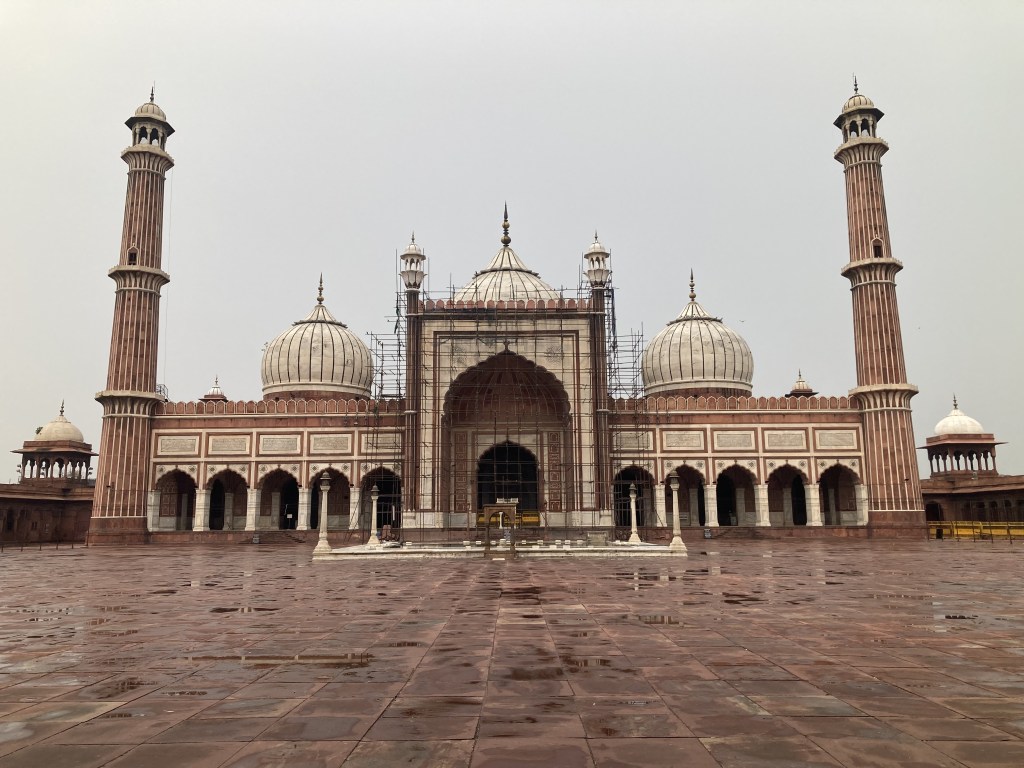
A man ushered us up the stairs, where we removed our shoes and placed them inside the bag we had brought for this very purpose. We paid the mandatory 300 rupee photography fee and stepped inside. Save for a few workers who were sweeping, we were the only people there.
As we walked around the courtyard of this iconic Mughal structure, I wasn’t thinking about how Jama Mosque was built from marble and red sandstone in the mid-1600s or that it is one of the largest mosques in India. Instead, I revelled in the stillness present. I enjoyed hearing the birds singing and watched a kit of pigeons flock to the courtyard for the birdseed someone had left for them. I loved how my feet felt as I stepped through shallow puddles the rain had left behind. It was easy to forget that one of the busiest areas of Old Delhi was just outside.
We came across a sign saying that the making of music videos was strictly prohibited. I would have never thought to even put up such a sign, but I suppose they had issues with this in the past?
Perhaps even more unexpectedly, we were also confronted with signs saying visitors could not go inside mosque. We were sure it was well after sunrise, so surely morning prayers had been completed. Perhaps they were cleaning it at that early hour. Wanting to be respectful, we didn’t push it. Besides, we quickly abandoned our disappointment when we spotted macaques flooding the courtyard. I loved watching them interact with each other as well as climb the structures like it was nothing, getting great views of the city, including the iconic Red Fort.
Walking Down a Market Street
Walking down a street in Old Delhi is like playing a live video game and it’s perhaps the bravest thing I’ve ever done. After a rest at the hotel (we were dealing with jet lag after all), we decided to go back out in mid-afternoon to what looked like a lively street, whose entrance was just across from the Jama Mosque. Unlike our early morning jaunt, the streets were considerably busier. Armed with our intention of simply walking around, we soon realized that there was nothing simple about walking around in Old Delhi. We also learned to completely ignore the amount of time gps said it would take to walk some place.
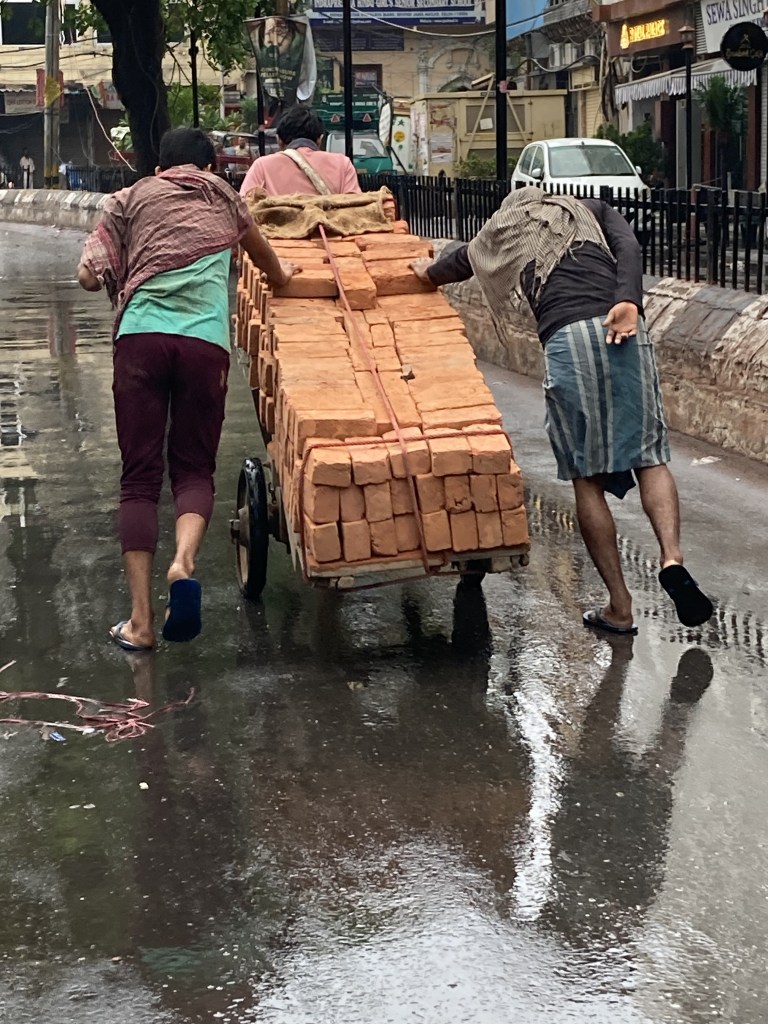
And so, I began inching my way down the street trying to take it all in simultaneously battling rickshaws (I was hit by three of them), the large amount of motorbikes, other people walking, dogs and even goats being dragged through the streets. To be honest, I found it stressful, always trying to find an opening and to avoid stepping in piles of garbage or potholes, sometimes filled with water, or the sudden and unexplained stray brick in the middle of the road.
I discovered that walking down an Old Delhi street is a feast for the senses! I found it overwhelming at times, because it seemed impossible to take notice of everything with my attention being grabbed in a different direction every second. I noticed a beautiful doorway, vibrant colors of fruit stands and the Kali statue on the corner that Chrissy pointed out. And anything and everything was for sale from beautiful dresses, to car parts to kitchenware as was a large array of services. Muslim men dressed in tunics and kufis (hats) and Hindu women wore beautifully decorated kurtas.
Sadly, I also saw some challenging images: a baby cow’s head laying in its side for sale and live chickens stuffed into a small metal cage waiting to be slaughtered.
Based on comments online and from friends who had visited India, I had been expecting an onslaught of unpleasant, even vial, odors in Delhi, but this was not my experience at all. I could imagine that the fact it had just rained might have subdued any such smells, coupled with low mid-March temperatures. I noticed a pleasant waft of spices as I passed a spice vendor and the incense from a store owner adding fragrance to the front of his shop. The worst odor I noticed was the unmistakeable smell of urine as I passed the outdoor urinals.
Walking down the street (any street in Old Delhi as I soon discovered) is a noisy affair. There is constant honking from motorbikes trying to work their way through, the crackling of electricity escaping the overworked power lines above, children crying and vendors announcing their wares. I also heard bracelets jangling as decorated women passed, the sizzling of street food being prepared and the splashing of discarded water store employees tossed after mopping the floor of their shop.
Among the utter chaos, I witnessed kindness. A woman’s plastic bag with a newly-purchased dress inside fell off the back of a rickshaw and I witnessed how complete strangers came together to retrieve it for her. At one point, I needed a break and decided to look up, where I saw a woman leaning out a third-story window, watching the chaos from above. She caught my gaze, we smiled at each other and she returned my wave. I will not soon forget the little girl who smiled and waved at me from the back of a rickshaw or the numerous people curious about me. It was hard to imagine that they had never seen someone like me before. While the starring sometimes caused me anxiety, I was also overjoyed when my smile was returned, connecting the human-ness of the other. It was such a simple, and yet profound, international exchange.
It started to rain and so, using the offline Google map I had previously downloaded, Chrissy and I slowly made our way back to the hotel, where we promptly washed (scrubbed more like it) our feet and sandals and dried out our clothes for the next day’s adventure.
Lal Qila (Red Fort)
We arose early the next morning and headed out to the Red Fort, which served as the main residence of the Mughal emperors. It was commissioned on May 12, 1638 by Emperor Shah Jahan when he shifted the capital from Agra to Delhi. It’s design is credited to architect Ustad Ahmad Lahori, the same person who built the iconic Taj Mahal.
I’m so glad we arrived early (around 8am) due to the few visitors at that hour, which made for a leisurely walk around. I seemed to be rather popular though, as the people who were there wanted a picture with me. I remember having a similar experience in China. It’s strange to think that WE are the exotic ones, but I can certainly relate to the curiosity in people from different cultures. After awhile though, the sheer number of requests did get overwhelming. Seriously, I was worried a line would form.
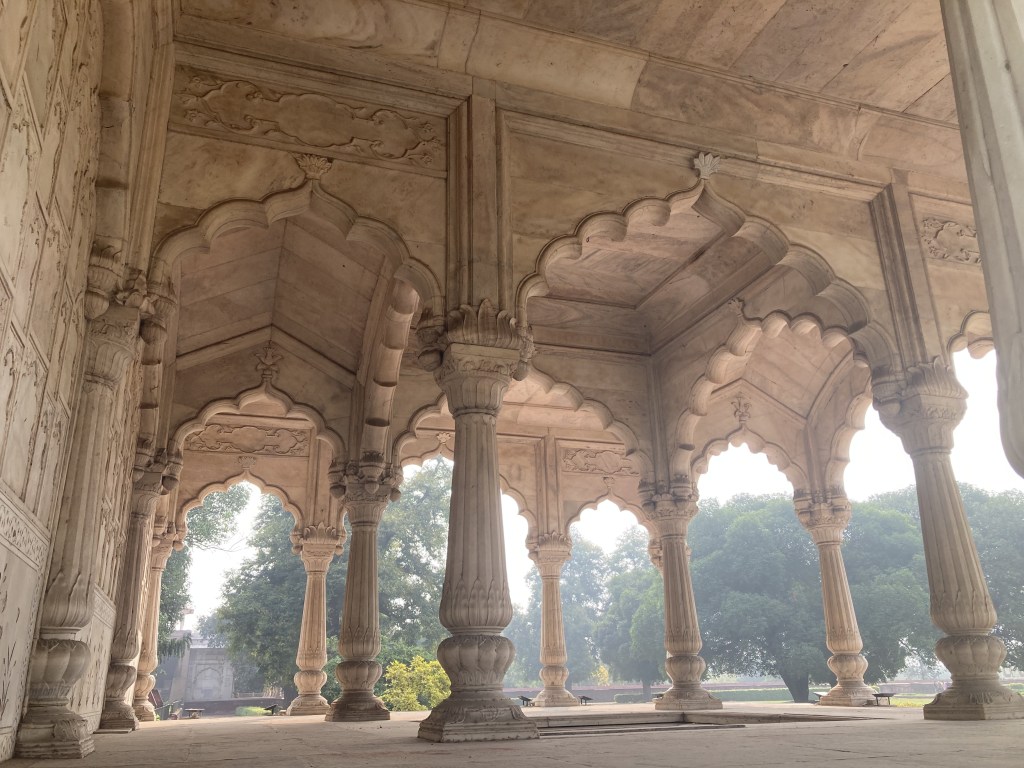
The Red Fort reminded me of the walled Forbidden City in Beijing. While the Chinese residential complex was the royal home to the emperor of the Ming Dynasty (1400s), this designated UNESCO World Heritage Site offered the opportunity to see Mughal architecture, some structures made with solid white marble. According to the signs in English, this large complex included a mosque (complete with its own harem apparently), a hammam (bath house) and a place for greeting the common people to listen to their concerns.
I enjoyed walking around the very edge of the complex, listening to birds that were foreign to me. It was surreal to see some peacocks and peahens walking along the bright red wall surrounding the grounds.
Chrissy spotted a group of puppies and squatted down. One brave puppy came over to her and the others followed. Before she knew it, she was smothered in puppy love. Chrissy was in heaven, no doubt missing her own dogs. Mom didn’t seem to mind that her babies were getting attention.

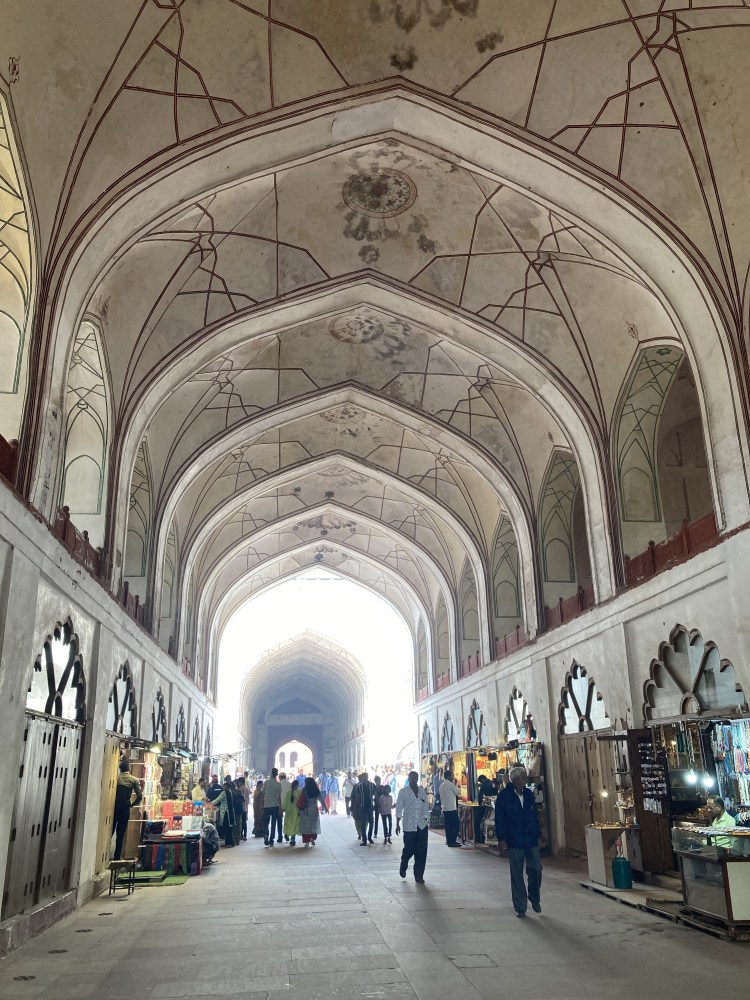
Upon leaving, we noticed a considerable increase in visitors. And the shop owners began setting up their market stalls in the Chatta Chowk, the historic covered market just inside the entrance. I picked up a pair of sunglasses on my way out. I was hoping this would help me with the social anxiety aspect brought on by being starred at so much.
Religious Experiences at Chandni Chowk
After leaving the Red Fort, Chrissy and I walked across the street to the beginning of Chandni Chowk, one of the most visited shopping areas in Old Delhi. With widened roads, this pedestrian only zone was much more pleasant than I had anticipated. What I hadn’t expected was the amount and variety of religious institutions along the way.

Even visible from the Red Fort, the first noticeable temple was a bright red Jain temple, situated on the corner of Netaji Subhas Marg and Chandni Chowk. Built in 1656, the Digambar Jain Temple is the oldest Jain temple in Delhi. As with all temples, we had to remove our shoes (and pay a fee to get them back). Unlike at the Jama Mosque, we were not allowed to place our shoes in a bag and carry them in.
Jainism is a religion that has intrigued me for a while due to its interpretation of Ahimsa, an ancient Indian principle that involves non-violence to all living beings. My understanding is that Jains do not eat animals and will go to great lengths to avoid harming them (except when consuming dairy for some reason). This is the reason that leather was not allowed in the temple. Not surprisingly, a multi-storied bird hospital stood on the grounds adjacent the temple. The birds included pigeons, parakeets, a peacock and several birds of prey. At the time of visiting, they were even taking care of a rabbit.
I stepped inside the temple with curiosity (photography was not allowed).Streamers hung from the ceiling and I heard singing and bells ringing. The place was decorated with beautiful murals clearly telling a story of some sort. Worshipers were leaving offerings in the form of rice, candles and flowers in front of the many statues of deities present. People did not seem bothered that non-Jains, like myself, were visiting. In fact, I received several smiles.
After paying a small fee to get our shoes back, Chrissy and I continued walking down the street, politely declining offers to take a rickshaw. We came upon a Sikh gurdwara with an adjacent welcome center. So, we went in.
A kind man greeted us and offered to teach us about his religion. We left our shoes once again, placed the mandatory head coverings on our heads and followed our guide back into the street. He walked us to a large white marble sink and said that Sikhs wash their hands before entering the hall. We did as well before following our guide up a series of carpeted steps which opened up into a beautiful large space. In the middle of the high ceiling hung a sparkling chandelier and the floor was covered in patterned carpets.

A crowd of people sat on the floor listening to the Sikh holy book being sung, which was done live at an ornate alter at the front of the hall. I learned that the holy book is sung 16 hour a day. Chrissy and I were invited to join the others on the floor and we did. It was peaceful and I felt my body relax while there. I could have stayed longer, but our guide was ready to move on.
After showing us a very special room that houses the Sikh holy book (at 9:30pm every evening the book is ceremoniously taken to this room to spend the night), we walked to the community kitchen. Our guide introduced us to a man making a dish in the biggest pot I have ever seen. We politely declined their offer to try the food because it included ghee (clarified butter).
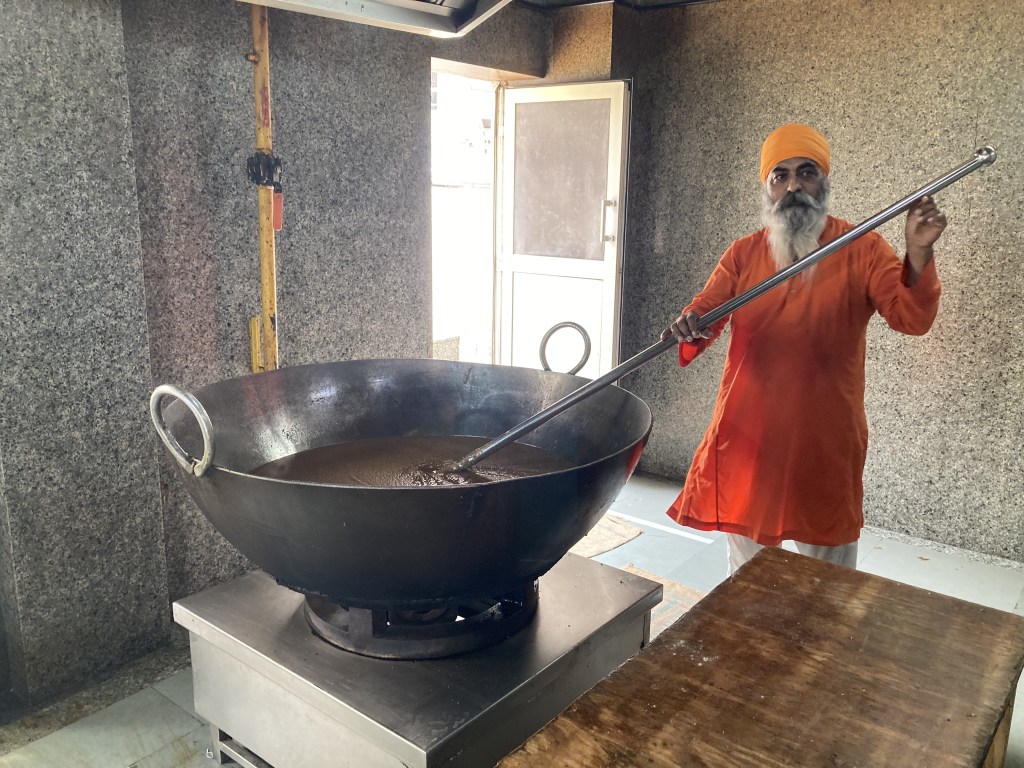
Chrissy and I also saw a group of women in an adjacent room sitting in a circle making the dough for chapatis, one of my favorite Indian breads. The dining hall consisted of rows of mats on the floor for people to sit and eat a plate of food. Our guide explained that everyone of all faiths is welcome, regardless of race or social status. He proudly stated that they serve thousands of people every day whether rich or poor and men and women of varying religions all sit next to each other and simply share a meal together. No one is ever charged a single rupee.
Our guide then walked us onto the terrace and talked about the historical significance of the Gurdwara Sis Ganj Sahib, first constructed in 1783. Apparently, this gurdwara marks the spot where the ninth Sikh Guru, Guru Tegh Bahadur, was beheaded on November 24, 1675 on the orders of the Mughal Emperor Aurangzeb. We left the Sikh visitor center with a brochure explaining the tenants of Sikhism and their stance on life.
Continuing down the street we came across a Baptist Church, which was connected to a school. The inside of the small church was as expected with rows of pews, an alter at the front and a crucifix. I sat in a pew for a bit and enjoyed the peaceful silence. It was also neat to see the Bible and hymn book in Sanskrit.
The Emotional Breakdown
After a rest at the hotel, we headed out again, this time to look for a mud wrestling event that apparently dated back to the 1600s and was to take place in a park just down the street from our hotel. We inched our way through the crowded street and found the park, but couldn’t find our way in.
Being on the street was stressful. I was pushed sometimes and I was worried about my feet getting run over by a tuk tuk, car, a huge bus, a motorbike or a rickshaw. Little did I know that in about half an hour, I would long to find that city street again.

At one point, we thought we found the entrance after walking through a mechanic yard, but we were quickly approached by two men questioning why we were there. It’s then that I saw all the dogs. Seeing that the way to the park was blocked, I realized we were on private property. I met the men with a smile and showed them where we were trying to go on the map. They returned my smile and pointed in a different direction. While the two men seemed kind and responded well to my “I’m sorry” body language, I became concerned about the dogs who were clearly territorial and guarding the exit. I was flooded with flashbacks of fleeing from packs of dogs numerous times when I lived in Thailand. I held my breath, was sure not to make any eye contact and swiftly headed to the exit. Chrissy followed closely behind me. I let out a big sigh of relief when we found ourselves in the mechanic yard again. On the way out, I was surprised to see numerous marijuana plants, the first of many I would see on that trip. While marijuana is illegal in India, the use of hemp seemed rather abundant.
Having joined the slow moving mob of people on the street again, we began walking around the park circumference searching for an entrance. Before we knew it, we had walked almost the entire way around the green space and we had reached the other side of the Jama Masjid metro station, allowing even more people to push their way into the crowd.

It turned out that we had entered a weekly Sunday open air market in a maze of small streets and alleys not marked on the dowloaded offline Google map I had. Not knowing how to get out, or how long it would take us to get out, added to my social anxiety and even caused some claustrophobia. It felt like personal space was becoming a distant memory.
At one point, a man behind me was pushing into me and rubbing himself on me, until I finally stopped moving and turned to give him a nasty look. He quickly left the area, but I was still affected and becoming quite anxious. When would this end? I just wanted to get back to the hotel , somewhere where I wouldn’t be starred at or fondled by strangers and would have room to move around. I felt trapped.
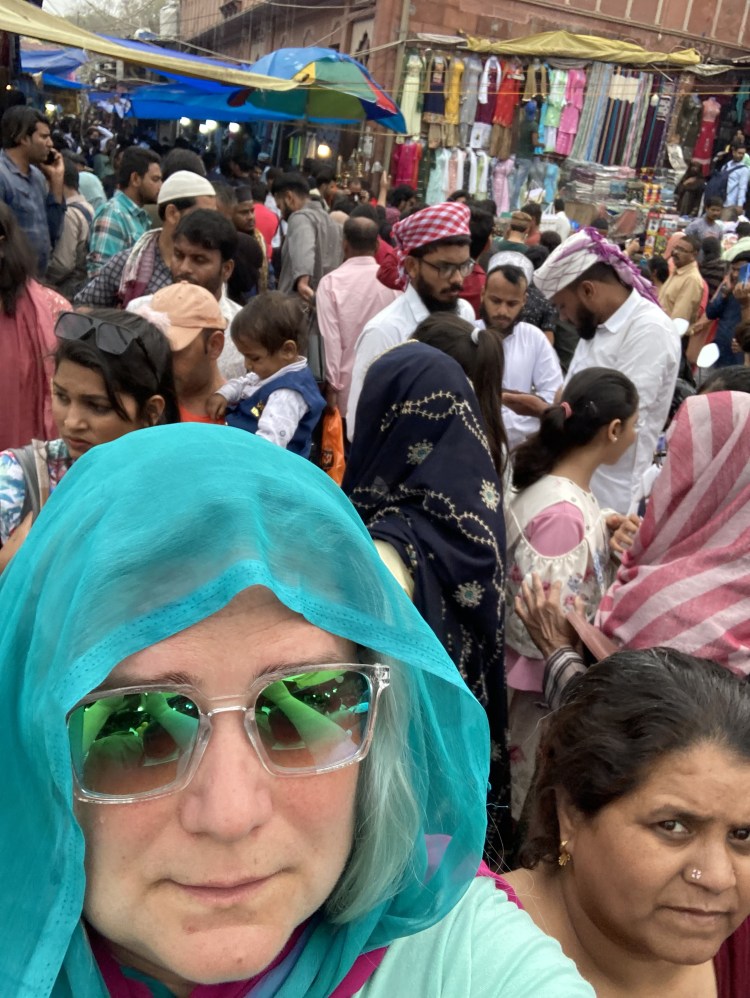
After a few twists and turns, we reached the familiar street, the one that would take us back to the hotel. I was relieved knowing that it was only a matter inching our way, constantly searching for any open space. It’s a shame that we never got to see the Indian wrestling. Perhaps the info online was pre-Covid? Who knows.
All I know is that when we finally got home, I collapsed on the bed and just had a good cry for a few minutes. I finally let out all the pent up anxiety from the prior couple of days . I eventually got up and showered and began feeling much better. I think I just needed the emotional release because walking on the crowded streets got a little easier from then on. Every crowd experience from here on out will always be compared to walking down the street in Old Delhi.
Tuk Tuk Ride Across the City
The following day, Chrissy and I decided to try a recently opened vegan restaurant in New Delhi. While it would have been much faster and cheaper to travel by metro, we decided it would be more of an experience to travel above ground. So, we negotiated with a tuk tuk driver to take us across town for 400 rupees (although we ended up giving him 500).
I must say that riding through Delhi traffic in a tuk tuk was much less stressful (even if it was slower at times) than walking through the mob scene. Riding also afforded me the opportunity to observe and enjoy the sights without worrying about the stresses of being a pedestrian. I got to witness daily life of a wide variety of people with various religions, backgrounds, professions and place in society.

It was an amazing way to people watch! We slowly passed all sorts of stores, make-shift fruit stands and motorbikes carrying way more than you would think could fit. Indians definitely know how to move product in bulk! We saw a man walking down the street carrying a communist flag. I don’t know if he had an end destination or was simply just walking around spreading his support of the communist party.
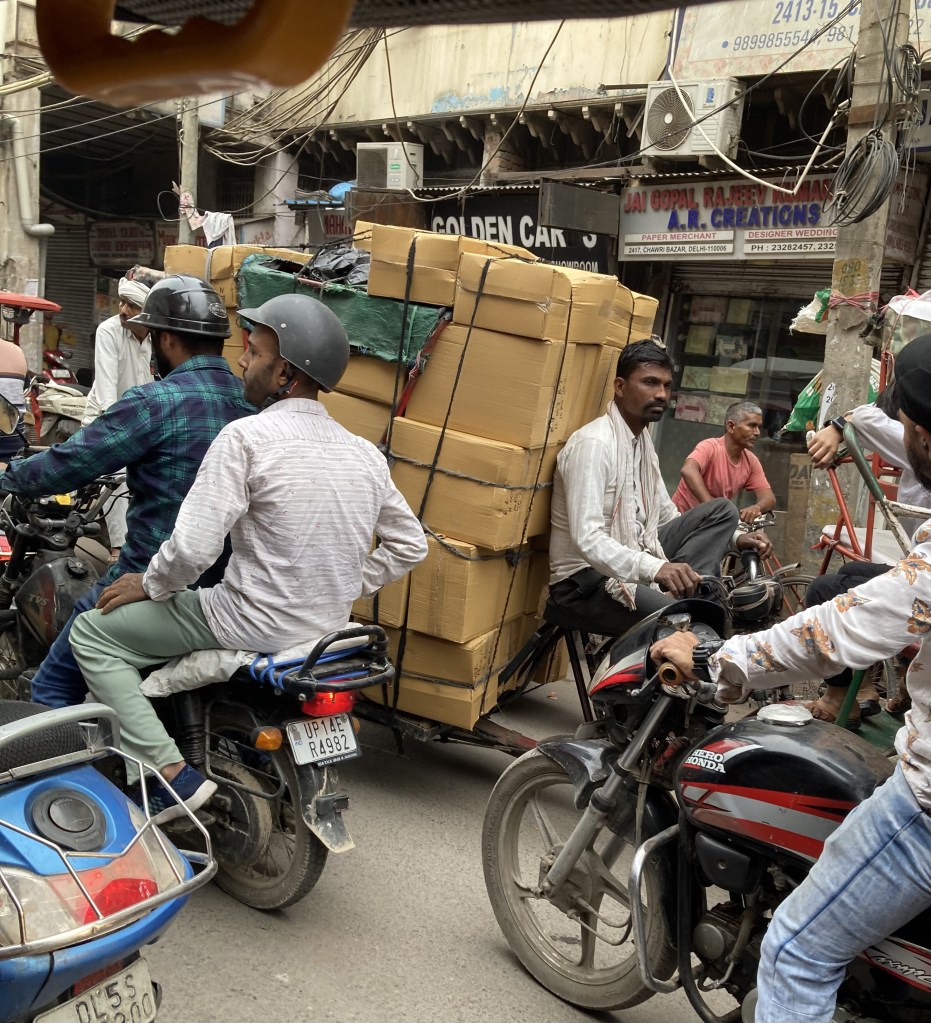
An unexpected aspect of the ride was the driver’s behavior. He seemed to check with me several times during the journey about the destination and even started talking to other drivers to ask them for directions. All this despite me showing him the gps map and even directing him by pointing to the exact road he needed to go to. But, for some reason he felt more comfortable pulling up next to another tuk tuk to discuss the way with a stranger, kind of making it a social affair.
At one point, we ended up in a small neighborhood road with major damage and the tuk tuk couldn’t get through. Several men came running over to help. One spoke English and confirmed where we wanted to go. I observed lots of men pointing the way, telling our driver to back up and where to turn. Still, he had to be told three different times from three different men and myself with a map in hand before he moved. I wondered if all this was for show, hoping for a larger payment?
The way back was no less eventful. I called the original tuk tuk driver and confirmed, with the help of an British visitor who spoke English and Hindi, that he was over an hour away. The kind man recommended using Uber with an Indian number (which I had) and explained how to change the default payment method to cash (we tried this later on without success). As a side note, I learned that the local drive share app is OLA, but in order to use this, you must have an Indian number AND an Indian credit card. Hotel staff had no problem ordering them for us when needed and we simply paid the driver in cash at our destination.
So, since the driver was not coming, I flagged down a tuk tuk and once again encountered a language barrier. We did our best to convey where we were going (Jama Mosque – our hotel was across the street) and came up with a price: 400 rupees. He was trying to tell us something in Hindi, but we couldn’t understand. Still, we got in the vehicle and he drove us to a bigger street with many tuk tuks waiting for rides. He found another driver and asked me for money and seemed to motion that this driver would take us. I was confused, so I enlisted the help of the public. I scanned the passersby to see who might be both friendly and English-speaking.
I walked up to a young man and asked him in Hindi if he spoke English. It turns out that he was walking with his entire family and they all immediately stepped aside to help. I was amazed at the result! They really advocated for us, haggling on our behalf. The result was having to pay the first tuk tuk driver 60 rupees for his efforts and the second driver would take us to Jama Masjid for only 200 rupees, half of what we originally agreed to.
The traffic became insane once we got to Old Delhi and the driver asked for 300 rupees, which we were happy to pay. Again, I found the behavior of the driver interesting. Two times along the way he pulled up to other tuk tuks, whose drivers were having a dispute, for the sole purpose of voicing his opinion on the matter at hand. But this caused even more traffic! Once, a tuk tuk driver who was behind us, got out of his vehicle in order to find out why our driver had stopped. “Go”, he said in English, most likely for our benefit. I left this experience with the strong idea that Indian culture included a major social component, more so than I was used to.
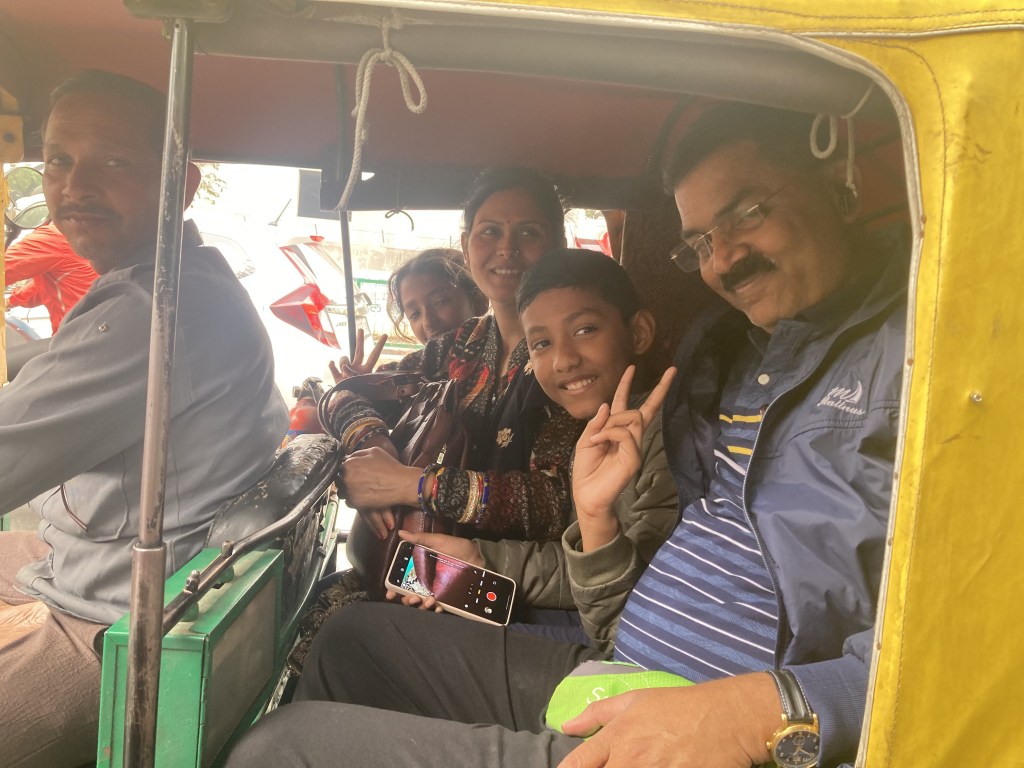
This, in fact, leads me to my favorite part of riding in a tuk tuk: sharing some truly beautiful moments of mutual kindness and curiosity, displayed in the form of a smile, a wave or the peace sign.

Rooftop Vegan Fine-Dining
After an eventful hour-long tuk tuk ride across the city, we arrived at Le Ambrosia, a fifth floor upscale rooftop vegan restaurant. (Note: Le Ambrosia might be temporarily closed. Hopefully, they open back up again soon.) Le Ambrosia had only opened two months prior to our visit (March 2023) and my taste buds and stomach were ready to enjoy a fancy vegan meal.
We first sat in tall chairs at a bar on the edge of the restaurant to overlook the city, but shortly before ordering, we noticed the dark clouds rolling in and decided we had better move to a table under the awning. When it rains, the seating selection becomes considerably smaller. From both seating areas, we enjoyed watching a big hawk soaring over the restaurant.
The menu was extensive and quite varied with a nice mix of cuisines. Wanting to try Indian-inspired dishes, I opted for the Black Gold for an appetizer and the Malabar Fusion for the main course. Black Gold included 22-karat pure gold foil and is apparently a vegan take on a Bombay specialty. The waiter told me that instead of using regular bread, they used charcoal bread to make the striking black color. This dish was served with gunpowder spice (milagai podi in Tamil) which is typically made with toasted curry leaves, sesame seeds, urad dhal (lentils), channa dhal (chickpea lentils) and dried Kashmiri chilies.

Malabar Fusion consisting of a crispy, flaky Malabar parotta (bread pictured in the back), chettinad tofu curry, gunpowder spice (in the spoon) and coconut caviar.

Longing for familiar dishes, Chrissy ordered the Classic Rings for an appetizer and the Smoked Portobello and Hemp Essence for her main. Chrissy’s appetizer consisted of crispy fried onion rings served with hot pepper sauce. The batter was made with chickpea and tamarind and they were indeed crispy.

Chrissy’s main course consisted of a sea salt roasted portobello steak, baba ghanoush nestled in deep fried kale, hemp seeds, bread, vegan caviar and hibiscus flowers. The “bread” that is included in the menu description might actually be khaman dholka, a steamed and fermented cake made from grain, flour and spices. It is often described as light, fluffy and mildly tangy and sweet. It had a firm spongy cake texture. But this is a guess on our part. Chrissy said this dish was delicious with very complementing flavors.

While we only spent a few days in Old Delhi, the memories we made in this busy city are sure to last a lifetime. After experiencing being merely a drop in the sea of humanity, I returned home very grateful for the amount of personal space I have. I walked around the block upon returning with my arms swinging, simply because I could, and my idea of what constitutes bad traffic has shifted momentously. I had heard some friends of mine describe their visit to Delhi, “I hated it and I can’t wait to return”. I now completely understand this sentiment.
 Vegan Vixen Ventures
This is a terrific narrative, Ligeia! You really brought the street scene alive! Laurel
LikeLike
Thanks for the supportive and positive feedback Laurel. I’m so glad you enjoyed my post. 🙂
LikeLike
I loved reading this! You did a great job bringing all the sights, smells and sounds of the old Delhi streets to the reader. I visited Old Delhi last week and stayed at a restored Haveli.
I must say I had the same experience like you did. I am from India and live in the US now.
LikeLike
Hi Rakhi, thank you so much for visiting my blog. I’m so glad you enjoyed reading this post and thank you for the compliment. Walking is Old Delhi is certainly an experience. So much to notice! 🙂 You may enjoy my post about Haridwar if you are interested. That was another interesting experience I had while in India. Enjoy your travels my friend 🙂
LikeLike