

Anyone who knows me even a little knows that I despise shopping. I get absolutely zero enjoyment out of walking around a store and feigning interest in a bunch of overpriced crap. As a firm believer of “if I’ve survived this long without it, I’m sure I don’t need it”, I can think of a million activities I would rather do than be in the market for anything. So, this begs the question, why on earth would someone who abhors shopping so much book a hotel for five nights in Tokyo’s most notorious high end shopping district with stores like Gucci, Louis Vuitton and some other brand I could care less about?
The answer is simple: for the food, specifically the vegan restaurants. I love staying in a location where I can walk to a variety of vegan eateries. Ginza offers a restaurant specializing in vegan junk food in a shopping mall, a vegan kissa (Japanese coffee shop – short for kissaten), as well as a prix-fixed fine-dining gastronomical experience in a high end vegan restaurant and everything in between. And I wanted to try it all! Plus, I discovered some non-shopping related spots to visit and interesting experiences to have in this extremely beautiful part of town, without having to drop a boatload of money on some high-end nonsense.
The land that Ginza occupies today was originally swamp land until it was filled in in the early 16th century. In 1612, a silver-coin mint was established, giving Ginza its namesake (Ginza means silver mine in Japanese). It wasn’t until after the Great Kanto Earthquake of 1923 that Ginza evolved into to the upscale shopping district that it is today, becoming the most famous district in Tokyo’s Chūō ward.
One of the very first things I noticed about Ginza is that it is the absolute cleanest place I have ever visited in the world! No trash in the gutters, no cigarette butts on the sidewalks and no graffiti on any surfaces. One morning, I even saw a man vacuuming the street in front of his store. I also noticed how quiet the streets were. Throughout my entire stay, I never heard a car horn even once. This was a stark contrast to almost any other major metropolis I have ever visited.
Here’s what I got up to during my four days in Ginza:
Tsukiji Hongan-ji
Located at 3 Chome-15-1 on the outskirts of Tokyo’s Ginza district, Tsukiji Hongan-ji easily stands out among the modern skyscrapers in the area. An online search of this temple revealed that, like most older buildings in Tokyo, it underwent quite a journey, involving a move and rebuilding two times after catastrophe hit twice. In 1617, a monshu (head of a monastery) named Junnyo Shōnin requested that a temple be built and his request was honored. It was first known as Edo-Asakusa Gobo and was built in Asakusa, a neighborhood north of Ginza. So, how did this temple end up in Tsukiji, in Tokyo’s Chūō’s district?
In 1657, the temple burned in a huge, citywide fire and the shogunate (military government at the time) would not allow rebuilding in Asakusa. So, the temple was rebuilt further south along the Sumida River, in an area today called Tsukiji, and was given a name change to Tsukiji Gobo. Followers used the temple for many years before it was destroyed in 1923, owing to the Great Kantō earthquake.

The present Tsukiji Hongan-ji was built from 1931-1934 and was designed by Itō Chūta, a famous Japanese architect who studied at Imperial University. The current building was clearly influenced by temples found in India and, having traveled to the India only a year prior, I easily noticed similarities in architecture. Today, many Buddhists view Hongan-ji as a pilgrimage destination because it houses important artifacts of Prince Shotoku, Shinran Shonin and Shonyō Shōnin, all important figures in Japanese history. Shonyō Shōnin, the 23rd monshu who passed away in 2002, known for successfully spreading Jodo Shinshu teachings abroad, is enshrined inside the temple (just to the left of the main altar).
In the front of the temple, I noticed additional gravestones, belonging to famous Bhuddhist teachers, and memorials dedicated to various important people, including a memorial to the Japanese people who lost their lives in Taiwan during WWII.
One of the features that I personally found visit-worthy was a large pipe organ in the main hall and from what I gathered on their website, a concert is performed there once a month during lunchtime. I was happy to see that all three musicians featured online were women. Unfortunately, my visit to Tokyo did not coincide with any such concert.

Entrance to the temple includes walking up a set of stairs and is free of charge, and I was surprised to see that shoe removal was not necessary. I confirmed with a guard on duty that non-flash photography is permitted and visitors are welcome to sit in one of the many chairs to view the architecture and watch a short video on a loop of ceremonies that take place there. At the top of the stairs a line had formed where people would take turns bowing, clapping and leaving a coin, all behaviors I would later learn are common at Shinto shrines.
Another feature of such a shrine is the existence of a cistern, a water source where visitors can cleanse their hands before entering. Tsukiji Hongan-ji had one of these too, but I didn’t know what it was at the time of my visit, having only learned about them afterwards. Later, when I actually used one in Kyoto’s Gion district (making sure to grasp the ladle with my right hand, fill it with water and pour it over my left and then do the same to the other hand), I was reminded of this very same action in the Jewish tradition. I had learned about the hand-washing ritual in the Jüdishche Museum (Jewish Museum) in Berlin, even having the opportunity to try it. I was then reminded of all the mosques I have visited around the world, where visitors are expected to wash their hands, feet and faces before entering. I remembered doing this in Jakarta, Indonesia, for example. I then thought of how Holy Water is used as the devoted enter a cathedral. Living in Thailand, I saw water being used as a cleansing vehicle (at Songkran, for example), as I did in Maya communities in Guatemala. It would seem that water, one of the basic elements, is used around the world for religious purposes. We are more connected than we realize I think.
Kabuki-Za Theater
Located in the Kabukiza Tower at 4 Chome-12-15, Kabuki-Za Theater is a theater dedicated to the Japanese art form of kabuki, dating back to the beginning of the Edo Period (1603-1867). Strangely, although kabuki was first founded by a woman, Izumo no Okuni, who formed a female troupe in Kyoto (even today a statue of her stands in the Gion district along the Kamo River), men quickly took over the art form and banned women from performing kabuki n 1629. Surprisingly, this ban still exists today and so kabuki is an all-male theatrical art form, meaning that every character onstage, including the female roles, is performed by men.

So what exactly is kabuki (歌舞伎)? I tried to educate myself as much as possible before attending the performances so I could get the most out of them as possible given my limited knowledge and experience. Here’s what I learned:
Interestingly and quite telling, the Kabuki’s kanji (one of the three scripts in Japanese and this one uses Chinese characters) that make up the word kabuki can be read as ‘sing’ (歌), ‘dance’ (舞), and ‘skill’ (伎). To me this makes complete sense as kabuki can be described as a classical form of theater that mixes dramatic performance and traditional dance. Kabuki can also be characterized by its elaborate costumes and a special kind of make-up called kumadori.
Similar to Chinese opera, Kabuki can also include both onstage and offstage music and sound effects. A performer, called tsuke, sits on the side of the stage and hits two pieces of wood against a board, creating a clattering sound intended to emphasize movements on stage. One of the most notable aspects, at least in my opinion, of Kabuki is the audience participation. Special attendees in the third balcony (where I was sitting), called Ōmukō, can be heard shouting out words of encouragement to the actors throughout the performance. This practice is called kakegoe and it’s only done by spectators who are very familiar with the performances as the timing must be correct.
Another telling feature of kabuki is the hanamichi, a raised passageway running perpendicular to the stage. Literally meaning flower road, the hanamichi is used to introduce new characters and can change into various scenes, like the ocean, the aisle of a castle or a road depending on the storyline.

During my online research, I also familiarized myself with a performance skill called mie, meaning pose, as well as the significance of various colors in the kabuki tradition. During a performance, an actor will strike and hold an exaggerated pose, emphasizing strength or a strong emotion. All the motion on stage also ceases, drawing attention to the character in mie. Often, a held mie ends the play and as everyone freezes, the curtain closes.
Costume and make-up color are major signifiers in kabuki. A performer’s kumadori indicates whether the character is young, angry, passionate, possesses bombastic strength, or is a hero (red can indicate all these). I read that blue or black lines on the face indicates villainy or jealousy, whereas green or brown signify the supernatural and audiences recognize purple as nobility. I made sure to pay attention to these visual indicators as I experienced the three plays I had secured tickets to for the May Program.
First Play: Oshi No Fusuma Koi No Mutsugoto (Sumo and Mandarin Ducks)
“Matano no Gorō, who loses to Kawazu no Saburō in a sumō match, gives up the courtesan Kisegawa to Kawazu as promised. However, the spiteful Matano plots to have Kawazu drink the blood of a male mandarin duck, a bird that is believed to have strong attachment to its partner, in order to disturb his mind and kill him. The spirit of a female mandarin duck appears whose partner was killed by Matano, as does the spirit of the male mandarin duck in the figure of Kawazu. The pair torments Matano mercilessly, venting the deep resentment they bear towards him, until finally they fly away.”
I found the kabuki stage to be much wider than other stages I’ve experienced. The first play was beautiful, in both presentation and storyline.
Second Play: Kenuki (The Whisker Tweezers)
“A princess has a mysterious ailment that makes her hair stand on end, and this prevents her from going ahead with her long-awaited marriage. Kumedera Danjō comes from the groom’s household to investigate and, when his tweezers mysteriously float up in mid-air, he discovers a secret plot. This is one of ‘The Eighteen Favorite Kabuki Plays’. This collection mostly features plays with the bombastic ‘aragoto’ style of acting, but ”Kenuki” is an urbane, witty detective story that unfolds in a world of fantasy. It displays the spirit of early kabuki.”
It was clear quite early on that Kenuki was well-known and well-received. It was full of melodrama and humor and the storyline was quite easy to follow, even without translation. This play was perhaps my favorite of the day.
Third Play: Kiwametsuki Banzui Chôbē
“In the early Edo period, gallant men like Banzui’in Chōbē were leaders among the ordinary townspeople. But this incurred the wrath of members of the samurai class who were theoretically in control. As the play begins, a fight breaks out inside a theatre which is settled by Chōbē, but Chōbē’s skillful arbitration frustrates the samurai Mizuno. A short time later, Mizuno invites Chōbē to visit his mansion. All of Chōbē’s men tell him not to go because it is a trap, but Chōbē decides to meet his end and bids farewell to his wife and son.”
Despite the fact that I could not understand most of this play as there was a lot of dialogue, it was quite clear that this play was the most serious of the three performances. The plot seemed more complex than the others as well, beginning with a “kabuki play within a play”. The end was quite dramatic with the lead character saying goodbye to his family before taking his life in the traditional samurai manner.
Between each play, there was a 30-40 minute intermission and honestly, the intermissions were almost as interesting as the plays themselves. The lobbies contained historical pictures and paintings to observe, as well as kabuki posters from decades prior. There were also food and drink vending machines and vendor stalls at which one could buy “kabuki crackers”, fans and other kabuki and non-kabuki related items. But, perhaps the most interesting aspect to the intermissions was the people-watching. Many of the attendees, especially the women on the ground floor, were all dressed up in beautiful kimonos. It seemed that a large portion of attendees brought their own bento boxes with them and they could be seen eating food in the lobby or right in their seats.
Although I had plenty of opportunities to rent a digital translator, I declined each time assuming that, much like at an opera, I could simply read the synopsis ahead of time and get the gist. I was worried that hearing a voice in my ear giving me the translation would somehow detract from the performance. I managed ok in the first play; however, during the second play, I wondered if I should have gotten the translation and the large amount of speaking (and very little music) of the third play led to a major regret on my part. If I ever go to a kabuki performance again, I will absolutely purchase the translation.
Okuno Building
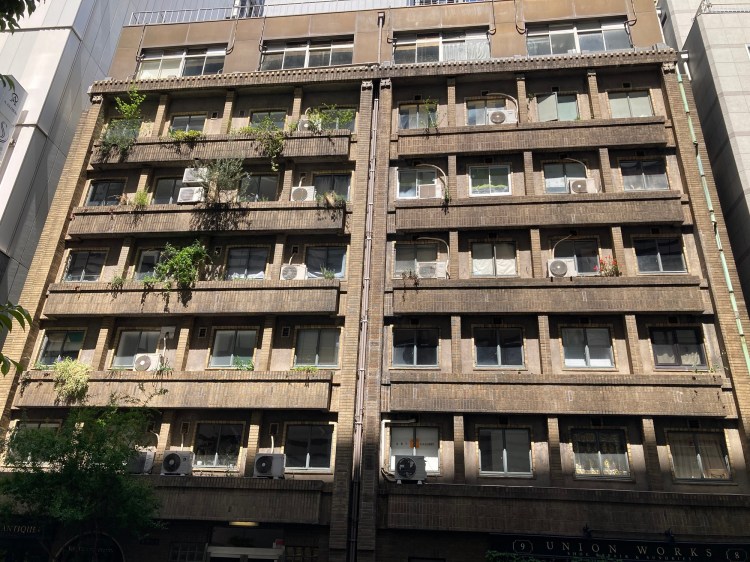
You wouldn’t know it by looking at it, but no one lives in the “Ginza Apartment Building”, now called the Okuno Building, dating back to 1932. While it used to house many residents, today it’s used as a studio space for artists. Located at 1 Chome-9-8 in Ginza, it’s a building that you would easily walk on by without even giving it a second glance. In fact, I had already walked by it a few times, before learning of the historic and artistic significance of this building. But one morning, I decided to go inside and have a look around. I met a cleaning woman in the lobby, who didn’t seem at all perturbed at my presence.
Just inside the door, I noticed the rows of mailboxes to the right, one for each art studio “apartment”. I was able to freely walk around the eerily empty building (actually two adjacent buildings that you can walk between), slowly walking up one of the two staircases, trying to notice everything. It felt like traveling back in time as the preservation of history was in the peeling paint and in every crack on the wall. I found it interesting to see how each artist decorated their door, some doing so very plainly with a simple sign, others with a “cool professor vibe” with notices of local events of interest and others used the space like a blank canvas, highlighting some of their own art.

The Room 306 Project
Shortly after the construction of building in 1932, a woman named Yoshiko Suda opened the Suda Beauty Salon in apartment 306. This woman would live to 100 years old and during her long life, she witnessed the start and end of WWII, the post-war construction and so much more. Yoshiko’s salon closed in the 1960’s, but she used apartment 306 as her residence until her death in 2009. She was the last resident of the original Ginza Apartments. Since Yoshiko’s passing, the space has been used as a non-profit project for artists to work on their individual projects. An aspect of the Room 306 Project that I personally find fascinating is that they are purposely not trying to preserve the original style of the space and also not intervening in the natural deterioration of the room. In this way, they are protecting the passage of time itself.
Toyoiwa Inari Shrine
Women come to the Toyoiwa Inari Shrine to ask for guidance with love and marriage. I saw women of all ages stop by. This shrine has apparently been in this exact location since the Edo period (1603-1867), hence the strange location in a back alley as the metropolis grew up around it. Present at all Inari shrines, the Toyoiwa Inari Shrine features foxes, who are considered messengers to the god Inari. It also features a shimenawa (a sacred rope) signifying that this is a sacred space. Traditionally, this rope is made from hemp, but may also be made of rice or wheat straw.

As I was leaving, a small group of women arrived to visit the shrine, no doubt eager to ask for guidance from the “guardian of romance”.
Mitsukoshi Terrace
In my opinion, the only redeeming quality of the famous high-end Mitsukoshi Department Store is the roof top terrace. After passing jewelry counters and other stuff I didn’t even register, I waited in line for the elevator and took it to the top floor. After stepping through the doors to the outside, it’s easy to forget that you are on top of a major department store. There is a nice expanse of grass in the middle with trees and flowers around the edges. I turned right to check out a small area of shrines with statues.
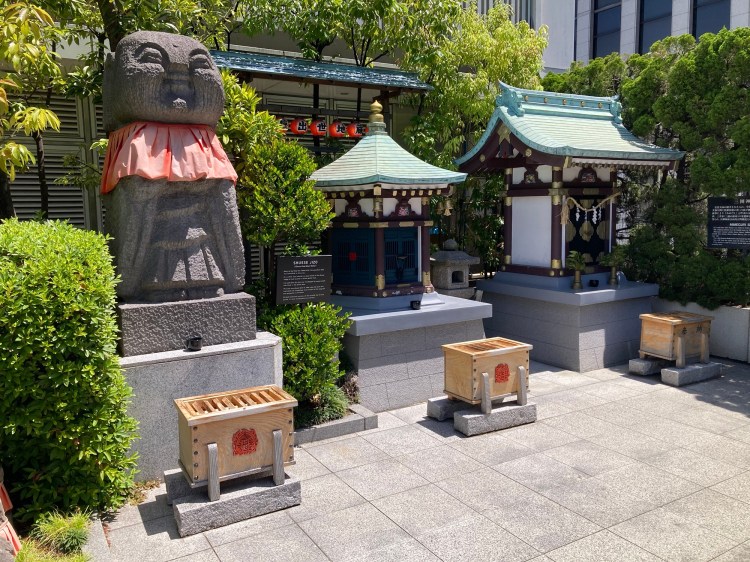
The Mimeguri Shrine was built by a great teacher in Japan named Kobo Daishi and the original one is said to be found near Mukojima Kototoi Bridge in the Mukojima district of Japan near the Sumida River. Local folklore states that in the year 840, a holy white fox encircled the shrine three times during the ceremony of reconstruction. Today, the shrine is dedicated to the God of the Mitsui family, the founders of the Mitsukoshi stores, which is why you will find the same type of shrine on the rooftop of all Mitsukoshi stores. Visiting the shrine guarantees that all your wishes will be granted, apparently.
In the same location stands the Shusse Jizo (a Ginza Guardian Deity). At some point between 1868 and 1912 (the Meiji era), this guardian deity was unearthed near the current day store. Jizo, a stone statue of the divine image of God, was placed at top of the Mitsukoshi Department Store in 1966 when the store was renovated. Many people who lived in the Ginza area worshipped this deity because it symbolizes luck and success in long life and prosperity in business. Cleary, this has worked for the Mitsui family! According to a sign there, a memorial service is held on the seventh day of each month and everyone is welcome.
Vegan Food in Ginza
Always making the top five most-vegan cities in the world, Tokyo had 123 all vegan restaurants listed on HappyCow at the time of visiting. Like seriously, the biggest challenge was narrowing down where to eat during my short stay. And what a wonderful problem to have! I decided to focus on vegan restaurants that were within walking distance of my hotel (Sotetsu Fresa) on the upper edge of the Ginza district.
2foods
2foods is a vegan restaurant with two branches in Tokyo, one in Shibuya and one in Ginza. Its proximity to my hotel and the fact that it stays open until 9pm made it the obvious choice for my first dinner in Tokyo after a long overseas flight that had only been made longer due to a three-hour delay.
Located at 4-6, Ginza 2-Chōme, inside Ginza Loft, I found 2Foods in the back right corner of the store on the ground floor of a shopping mall. I immediately loved two things about this vegan eatery: 1) how colorful everything was from the signage to the donuts and 2) the “yummy, but also healthy” branding, creating healthy junk food options.
Thankfully, they offered free wifi, so I could gain access to their menu via the QR code at each table. I decided to try the sampler which included a curry dish, a vegan egg dish and a burger. Patrons could choose between the Japanese original curry and the just like butter chicken curry, the omurice (vegan omelette rice) with demi-glaze or with ketchup and the junk burger or the teriyaki avocado burger.

I was super pleased with the sampler, a perfect way to get a taste for the various options on the 2Foods menu. Each dish had a very bold and unique combination of flavors. Interestingly, their vegan eggs, called Ever Egg, is their own brand and made from carrots and white beans and if I lived in Tokyo, I would have purchased a few Ever Egg products from the freezer there. You can read more about this product and others here and 2Foods also provides two recipes using Ever Egg online. I left the restaurant full, satisfied and very ready for bed after my long travel day.
Ain Soph
Ain Soph is so popular that I had to book a binding reservation weeks in advance. Located at 4 Chome-12-1 Ginza, this fine-dining vegan restaurant is housed in a rather unassuming narrow building on a major city street. The façade features rows of balconies overgrown with all sorts of plants giving it a very appropriate “nature is more powerful than concrete” vibe.
I had a reservation for 5:30pm and was directed to walk up the stairs to the second floor, where I was promptly ushered to a small table next to a big window with views overlooking the street below. There were only three other tables.
With my reservation, I had pre-ordered the kissyhōten, a 5-course fixed menu, and after reading rave reviews of their pancakes, for an additional 1500 yen, I selected the pancakes for the dessert course. Kisshōten, a Japanese female deity that corresponds to the Hindu goddess Lakshmi, is apparently the goddess of happiness, fertility and beauty. Needless to say, I had high hopes for this meal.
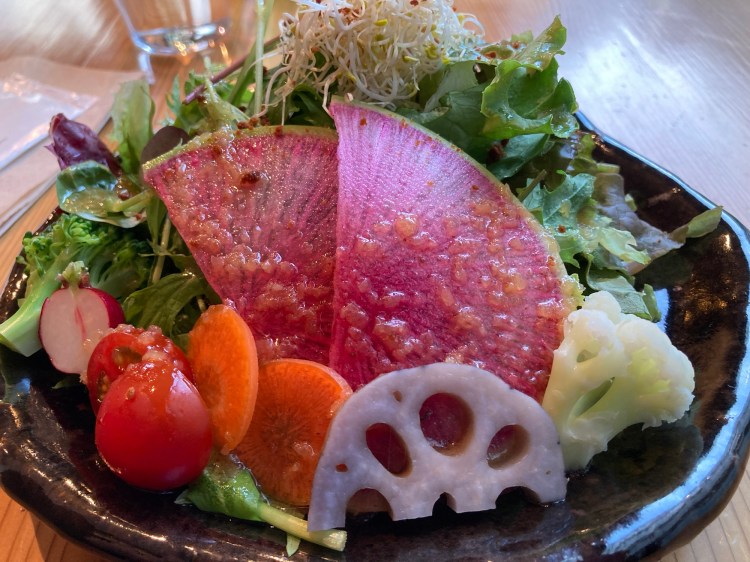
First Course: The Salad
The pleasant and enticing aroma of the salad dressing was the first thing I noticed when the waitress brought me the first course. The second thing I noticed were the vibrant colors! Tasting the salad revealed that only the highest of quality vegetables had been selected for this dish, which included a variety of lettuces, carrots, cherry tomatoes, cauliflower, broccoli, sprouts and two types of radishes. Vegan bacon bits added a smoky flavor which emphasized the freshness of the ingredients and combined well with the tanginess of the dressing. In short, there was nothing subtle about this salad; it was beautifully bold in every way, and it set the bar high for the rest of the experience.
Second Course: The Soup
The second course was a potato potash that gave my palette exactly what it needed, as it was the perfect antidote to the prominent start to the evening. Lighter than expected, the flavor profile was subtle and slowly revealed itself. It brought me to a place of calm and warmed my soul, preparing me for the next two courses, which were brought together.
Third Course: The Bento Box
As the waitress placed the wooden bento box in front of me and took off the lid, I realized this was my first bento experience ever. And removing the lid revealed the most intricate course, with nine little boxes featuring nine little masterpieces. At the beginning, I found it quite a challenge to eat, feeling like I was disturbing beautiful works of art. The dishes included soy meat karaage (a type of Japanese cooking whereby foods are deep fried in oil), sesame tofu, mushrooms with Genovese sauce, Spanish omelette, crown daisy greens with white tofu dressing, ratatouille, hummus with baby corn and cauliflower, and some sort of white root vegetable that surprisingly tasted light and fluffy with fennel seeds. Ain Soph even got me to like raisins; they accomplished this amazing feat by putting them with carrots, fresh dill and an amazing sauce that tied everything together.
There was only one problem! I was starting to get full and I had two more courses to go.

Fourth Course: The Sushi
The fourth course consisted of three pieces of sushi served on a charcoal slate, each one unique from the others. I began with the one on the very right, placing the entire piece in my mouth, allowing for all the flavors to work their magic, knowing this was the very first sushi experience I would have in Japan. I was surprised at the sweetness. The middle piece had a more savory taste and the third one was my favorite, the perfect balance of sweet and savory.
Fifth Course: The Dessert
I was asked if I would like the traditional Ain Soph pancakes or if I’d like to try the seasonal. Apparently, strawberries were in season in Japan and being from the Tampa area, I am all too familiar with strawberry season and how delicious they taste when eaten close to the source. So, I opted for the strawberry seasonal pancakes and waited, wondering how I was going to find space for them in my stomach.

Ain Soph pancakes are made with domestic rice flour and are fluffy and moist. In addition, this dessert includes house made ice-cream and cream and seasonal fruit, in this case strawberries. I honestly do not know if I have the vocabulary or writing skill to accurately describe the experience of eating this final course of the evening. Despite being already full, as one fork full dissipated in my mouth, my taste buds were already looking forward to the next bite. To say that this was a religious experience would not be an overstatement. As I enjoyed the fluffiest pancakes I’ve ever had, I reminded myself over and over again to make sure to completely enjoy each bite, fully knowing that I was spoiling all future pancakes for myself, for they would no doubt always be compared to these pancakes. Ain Soph somehow took pancakes to heights of loftiness that I never knew existed!
Needless to say, I left the restaurant (to waddle back to my hotel) utterly satiated with my gastronomical vegan fine-dining experience.
Komeda is
Located at 1-chōme-13-1 Tsukiji, Komeda is open every day from 7am-10pm, making it a great place to enjoy a meal anytime of day. It’s the only vegan eatery I could find that serves breakfast, with all other vegan restaurants in the area not opening until 10, 11 or 11:30am.
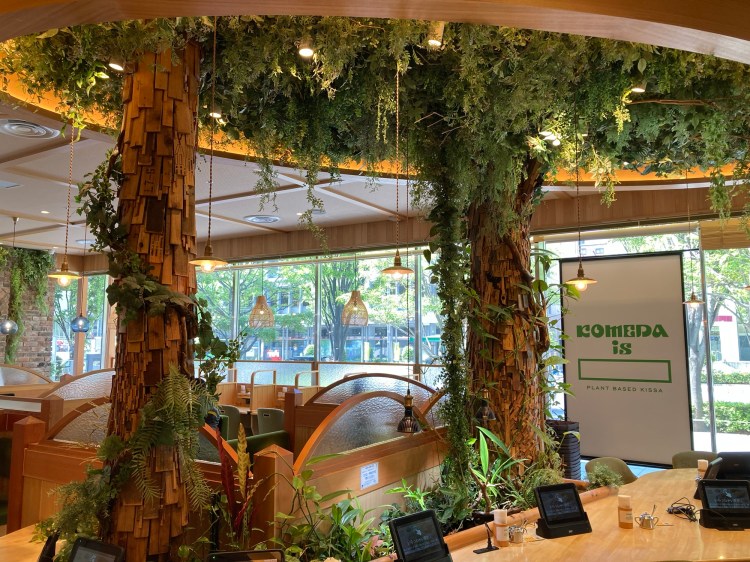
Komeda is is a beautiful little restaurant with a warm and welcoming vibe. I was greeted immediately upon entering and guided to a table. There is an ipad at each table where you can peruse the menu and order. A bill comes when the food is delivered to your table and you pay at the cashier after you’ve enjoyed your meal. I got the tofu fritters, which came with miso powder, tartar sauce and leek paste. I also tried the sumptuous grains salad with sesame dressing. Both were very flavorful and filling.

One day I ate both breakfast and dinner at Komeda is, a meal flanked on both sides of three kabuki performances at the Kabuki-za Theater just a block away. For breakfast, I ordered an orange carrot smoothie and it came with homemade bread. Out of four options: jam, vegan cream cheeze, ogura (sweet red bean paste) or minestrone, I chose the ogura, because it was unlike anything I could get at home. I’m so glad I did, as the bread was the softest bread I’ve ever had! Not a bad way to start the day.

After sitting for 4.5 hours at the theater, I was hungry. For an early dinner, I tried Komeda is’ wasabi tartar burger, which comes with fries, and a berry amazake smoothie. This was the first time I’ve ever eaten a burger with seaweed on it, and I loved both the flavor and the crunch. The bold flavor of the wasabi tartar was fantastic, and the freshness of the berry smoothie hit the spot!
Hug and Kiss Cafe
Dining at Hug and Kiss Cafe is by reservation only. According to their website, it seems it’s a cooking school as well as a restaurant. I couldn’t figure out how to make a reservation online, so I sent them an email using their contact form. I used this form and, with the help of Google, translated the details: name, phone number, address and inquiry. Unfortunately, I never heard back from them. If you do manage to get a reservation, the address is 7-14, Ginza 7-Chōme.
T’s Tantan Tokyo JR Station
Technically in Ginza’s neighboring district of Chiyoda, T’s Tantan definitely deserves a mention. On my last evening in Tokyo before heading back to the Haneda Airport the next morning to fly to Yakushima, I braved the rain and walked to the Tokyo Train Station. Due to this highly acclaimed vegan eatery’s location being past the ticket machines, I had to purchase a platform ticket for 150 yen (less than $1USD at the time of writing). Once inside, I followed signs for Keiyo Line, and there it was, on the right at the end of the corridor.
Having recognized the restaurant from so many videos I had watched online of people navigating their way there, my excitement grew as I said, “ichi hito kudasai” (one person please) before being escorted to a small individual booth. Using the ipad on the wall in front of me, I ordered the black sesame ramen to dine there and 12 gyoza to go.

So, did the meal live up to all the hype? A huge resounding YES! It was flavorful and thick with a super rich earthy flavor. The spice slowly built with each spoonful, enhancing the many flavors of this dish, that all seemed to work together to make the meal truly amazing. The variety of textures was phenomenal as well, with the creaminess being offset by the crisp crunchiness of the blanched fresh vegetables. A truly delicious dish!
I was also able to buy T’s Tantan VEGAN NOODLES at Natural Lawson convenient stores (called konbinis). These “cup-of-noodles” type containers were perfect to eat in my hotel room as they only need a little hot water to make.
I thoroughly enjoyed my four days in Tokyo’s Ginza district, discovering off the beaten path gems and happily walking past those waiting in lines to enter high end shops, as I made my way towards another awesome vegan restaurant. On my final day in Tokyo, I got up super early to head back to the airport to take two flights to the Japanese island of Yakushima!
 Vegan Vixen Ventures
Ligeia, this might be your best ever! Thanks so much for doing these blogs on your experiences! I hope you do more on the rest of your Japan trip! My son is headed there in November, and I forwarded your blog to him 🙂 ! Laurel
LikeLike